

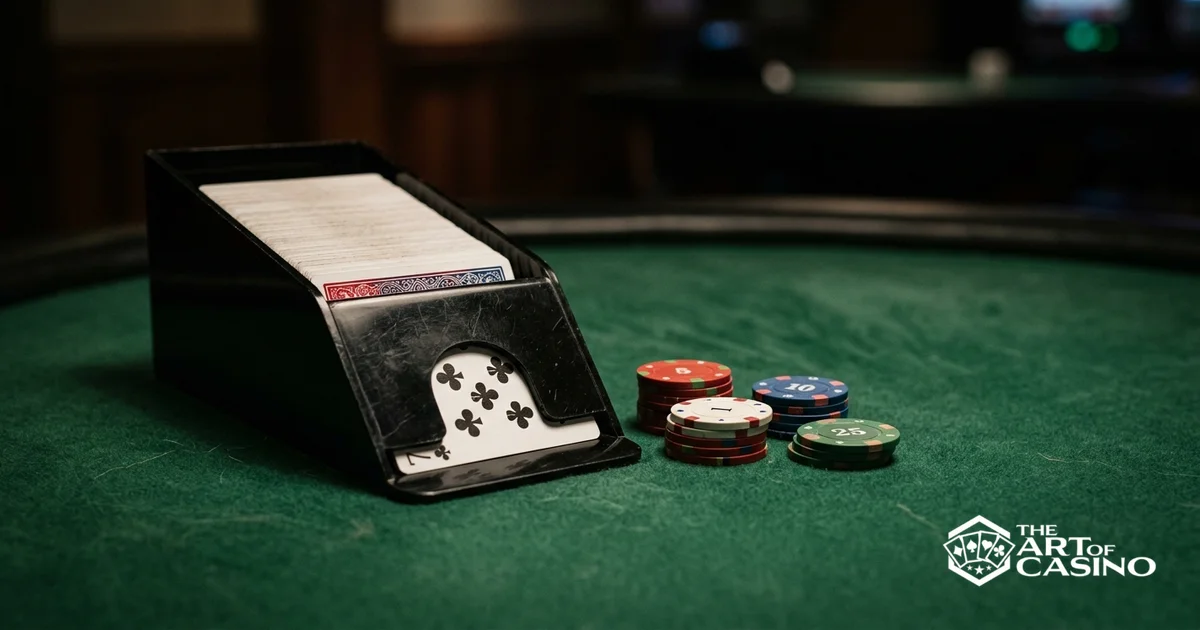
Card counting is the most famous advantage play technique in gambling history. It's been romanticized in movies, feared by casinos, and misunderstood by almost everyone. Here's what card counting actually is, and isn't.
What Is Card Counting?
Card counting is a technique for tracking which cards have been played in blackjack, giving you information about which cards remain in the deck.
The core principle: When the deck is rich in high cards (10s, face cards, Aces), the player has an advantage. When it's rich in low cards, the house has an advantage.
What counters do:
- Track the ratio of high to low cards remaining
- Bet more when the deck favors the player
- Bet less when the deck favors the house
- Make strategy adjustments based on the count
What counters don't do:
- Memorize every card played
- Predict the next card
- Win every hand (or even most hands)
- Guarantee profits
Why High Cards Help the Player
Blackjack Pays 3:2
When the deck is rich in 10s and Aces:
- Player blackjacks are more likely
- Blackjacks pay 3:2 (1.5x your bet)
- This asymmetry favors the player
The dealer also gets more blackjacks, but they only push against player blackjacks; they don't pay 1.5x.
Dealer Busts More
The dealer must hit on 16 or less. When the deck has more high cards:
- Dealer draws 10 onto 12-16 more often
- Dealer busts more frequently
- Players win more hands
Doubling Down Works Better
When you double on 10 or 11:
- High cards remaining = better chance of 20 or 21
- Low card deck = more 12-16 stiffs
Insurance Becomes Valuable
When the deck is very rich in 10s:
- Insurance bet (dealer has blackjack when showing Ace) becomes +EV
- With Hi-Lo, this happens at a true count of +3 or higher, matching the insurance index in the deviations section below
- Normally a bad bet, insurance becomes profitable in specific situations
How Counting Systems Work
The Hi-Lo System
The most popular counting system assigns values:
| Cards | Value |
|---|---|
| 2, 3, 4, 5, 6 | +1 |
| 7, 8, 9 | 0 |
| 10, J, Q, K, A | -1 |
As cards are dealt, you keep a "running count" by adding values:
Example sequence:
- K dealt: -1 (running count: -1)
- 5 dealt: +1 (running count: 0)
- 3 dealt: +1 (running count: +1)
- 10 dealt: -1 (running count: 0)
- 6 dealt: +1 (running count: +1)
- 2 dealt: +1 (running count: +2)
A positive count means more high cards remain. A negative count means more low cards remain.
The True Count
In multi-deck games, you convert running count to "true count" by dividing by remaining decks:
Running count: +6, 3 decks remaining True count = 6 ÷ 3 = +2
Running count: +6, 1 deck remaining True count = 6 ÷ 1 = +6
The true count gives a standardized measure of deck richness.
Other Counting Systems
| System | Complexity | Accuracy |
|---|---|---|
| Hi-Lo | Simple | Good |
| Hi-Opt I | Moderate | Better |
| Hi-Opt II | Complex | Higher |
| Omega II | Complex | Higher |
| Wong Halves | Very Complex | Highest |
More complex systems are more accurate but harder to use without error.
Bet Spreading
Counting alone doesn't beat the game. You must also bet more when you have the advantage.
Basic Bet Spread
| True Count | Bet Size |
|---|---|
| 0 or negative | Minimum |
| +1 | Minimum |
| +2 | 2x minimum |
| +3 | 4x minimum |
| +4 | 6x minimum |
| +5+ | 8x minimum |
Example: $10 minimum bet
- TC -2: Bet $10
- TC +2: Bet $20
- TC +4: Bet $60
- TC +6: Bet $80
The Problem with Spreading
Big bet spreads attract attention. Betting $10 then suddenly $100 is an obvious tell. Casinos look for exactly this pattern.
Playing Deviations
Beyond bet sizing, counters adjust basic strategy based on the count:
Common Deviations
Insurance:
- Normally: Never take insurance
- With TC +3 or higher: Insurance becomes +EV
16 vs. 10:
- Normally: Hit
- With TC 0 or higher: Stand (more 10s mean dealer busts more)
15 vs. 10:
- Normally: Hit (or surrender)
- With TC +4 or higher: Stand
10 vs. 10:
- Normally: Don't double
- With TC +4 or higher: Double
These "indices" squeeze out additional edge.
The Actual Edge
Best Case Scenario
With perfect play, optimal conditions, and aggressive bet spread:
- Player edge: 0.5% to 1.5%
Realistic Scenario
Typical counter facing modern conditions:
- Player edge: 0.5% to 1.0%
What This Means
Hourly expectation (theoretical):
- Average bet: $50
- Hands per hour: 80
- Total wagered: $4,000
- At 1% edge: $40/hour expected profit
But variance is enormous. You can be "playing perfectly" and lose thousands over many hours.
Why It's Hard
Mental Demands
You must simultaneously:
- Track the count (every card, continuously)
- Calculate true count (estimate decks remaining)
- Adjust bet size (without being obvious)
- Make correct basic strategy plays
- Apply playing deviations
- Maintain conversation/act natural
- Handle distractions (loud casino, cocktails)
- Manage emotions (during losing streaks)
Any error costs money.
Variance
Even with an edge, short-term results are unpredictable:
- You can lose 10+ sessions in a row
- Standard deviation is much larger than expected profit
- Need substantial bankroll to survive swings
Example: A counter with 1% edge might need 50+ hours to be statistically confident they're ahead.
Casino Countermeasures
Casinos actively fight counters:
- Shuffling machines (continuous or more frequent)
- Fewer decks dealt out (penetration)
- Surveillance for bet spreading
- Backing off suspected counters
- Banning skilled players
Modern casinos make counting harder than ever.
Is Card Counting Legal?
In Your Head: Yes
Using your brain to track cards is completely legal. There's no law against thinking or remembering.
With Devices: No
Using electronic devices or apps to assist counting is illegal in most jurisdictions.
Casino Response: Legal
Casinos are private property. They can:
- Ask you to leave
- Ban you from the property
- Share your information with other casinos
- Refuse to deal blackjack to you
- Call police for trespassing (if you return after being banned)
They cannot:
- Confiscate your winnings (legally won)
- Have you arrested for counting
- Physically detain you without cause
What Casinos Do
Detection Methods
Betting patterns: Flat betting then sudden large bets.
Playing deviations: Insurance at weird times, standing on 16 vs. 10.
Win rate: Consistent winners get scrutinized.
Surveillance: Dealers tap in counters; pit bosses observe; eye-in-the-sky tracks.
Software: Some casinos use AI to analyze betting patterns.
Countermeasures
Increased shuffle frequency: Reduces positive count opportunities.
Continuous shuffling machines: Essentially eliminate counting advantage.
Reduced penetration: Only dealing 50% of shoe.
Flat betting enforcement: Forcing consistent bet sizes.
Backoff: Politely asked to stop playing blackjack.
Banning: Permanent exclusion from property.
Should You Learn to Count?
Honest Assessment
Counting is:
- Mentally demanding
- Time-intensive to master
- Dependent on finding good conditions
- Subject to high variance
- At risk of detection and banning
- Far less lucrative than movies suggest
Hourly expectation:
- Entry-level job: $15+/hour guaranteed
- Card counter: $20-50/hour theoretical, but huge variance, stress, and potential ban
Who It Works For
Card counting might make sense if you:
- Find the intellectual challenge rewarding
- Have a substantial bankroll (commonly several hundred to about 1,000 betting units, depending on bet spread and risk tolerance)
- Can handle high variance emotionally
- Live near casinos with beatable conditions
- Enjoy the "cat and mouse" game with casinos
- Don't need the money to live on
Who Should Skip It
Counting isn't for you if you:
- Want consistent income
- Have limited bankroll
- Get stressed by losing streaks
- Can't act naturally in casinos
- Would be devastated by being banned
- Think it's a get-rich-quick scheme
The Reality of Modern Counting
Conditions Have Changed
The movie-era conditions don't exist anymore:
- Single deck games are rare (and have bad rules)
- Most games use 6-8 decks with poor penetration
- Continuous shuffling machines are common
- Surveillance technology is sophisticated
- Counter-detection expertise has grown
It's Still Possible
Dedicated players can still find edges:
- Some casinos maintain beatable conditions
- Online live dealer games offer possibilities
- Team play distributes risk
- Cover play extends longevity
But the low-hanging fruit is gone.
The Bottom Line
Card counting is real, legal, and theoretically profitable. It's also difficult, variance-heavy, and increasingly countered by casinos.
If you want to learn counting:
- Start with Hi-Lo system
- Practice extensively at home
- Develop perfect basic strategy first
- Understand the bankroll requirements
- Accept that you may be banned
- Have realistic expectations about profit
If you just want to play good blackjack:
- Learn perfect basic strategy (0.5% edge against you)
- Find good rules (single deck if available, 3:2 blackjack)
- Set loss limits and walk away when hit
- Enjoy the entertainment value
Card counting can turn blackjack from a losing game into a winning one, but the movies dramatically undersell how hard that transformation really is.