
Whether you're playing Texas Hold'em at a casino or in a home game, knowing hand rankings is fundamental. This guide covers every poker hand from best to worst, with odds and examples.
Standard Poker Hand Rankings
From highest to lowest:
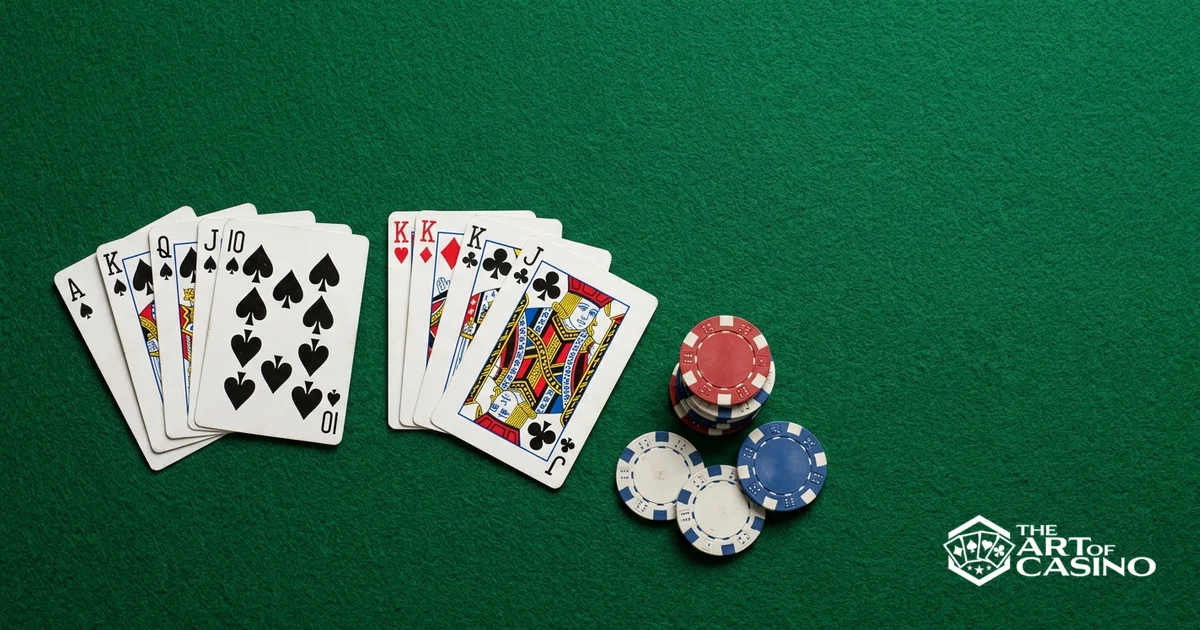
1. Royal Flush
The best possible hand.
A, K, Q, J, 10, all the same suit.
Example: A♠ K♠ Q♠ J♠ 10♠
Odds (random 5-card hand): 1 in 649,740 (0.00015%)
Only one royal flush is possible per suit. All royal flushes are equal, if two players have royal flushes in different suits, they split the pot.
2. Straight Flush
Five consecutive cards of the same suit.
Examples:
- 9♥ 8♥ 7♥ 6♥ 5♥
- Q♦ J♦ 10♦ 9♦ 8♦
- 5♣ 4♣ 3♣ 2♣ A♣ (the wheel/steel wheel)
Odds (random 5-card hand): 1 in 72,193 (0.0014%)
Higher straight flushes beat lower ones. K-Q-J-10-9 beats 9-8-7-6-5.
The ace can play low (A-2-3-4-5) but not wrap around (Q-K-A-2-3 is not a straight).
3. Four of a Kind (Quads)
Four cards of the same rank.
Examples:
- 7♠ 7♥ 7♦ 7♣ K♠
- A♠ A♥ A♦ A♣ 2♠
Odds (random 5-card hand): 1 in 4,165 (0.024%)
Higher quads beat lower quads. Four aces beats four kings. If multiple players have the same quads (using community cards), the highest kicker wins.
4. Full House (Boat)
Three of a kind plus a pair.
Examples:
- K♠ K♥ K♦ 4♠ 4♣ (Kings full of fours)
- 8♠ 8♥ 8♦ A♠ A♣ (Eights full of aces)
Odds (random 5-card hand): 1 in 694 (0.14%)
The three-of-a-kind component determines ranking. Aces full of twos beats kings full of aces. If trips are equal, higher pair wins.
5. Flush
Five cards of the same suit, not in sequence.
Examples:
- A♠ J♠ 8♠ 6♠ 2♠
- K♥ 10♥ 7♥ 4♥ 3♥
Odds (random 5-card hand): 1 in 508 (0.20%)
Highest card determines winner. A♠-J♠-8♠-6♠-2♠ beats K♠-Q♠-J♠-9♠-8♠. If highest cards are equal, compare the next highest, and so on.
6. Straight
Five consecutive cards of mixed suits.
Examples:
- 10♠ 9♥ 8♦ 7♣ 6♠
- A♠ K♥ Q♦ J♣ 10♠ (Broadway)
- 5♠ 4♥ 3♦ 2♣ A♠ (the wheel)
Odds (random 5-card hand): 1 in 254 (0.39%)
Higher straight wins. Broadway (A-K-Q-J-10) is highest. The wheel (5-4-3-2-A) is lowest. Ace can be high or low but not both (K-A-2-3-4 is not a straight).
7. Three of a Kind (Trips/Set)
Three cards of the same rank.
Examples:
- Q♠ Q♥ Q♦ 7♠ 3♣
- 5♠ 5♥ 5♦ A♠ K♣
Odds (random 5-card hand): 1 in 47 (2.1%)
Higher trips beat lower trips. If equal, highest kickers determine winner.
Terminology:
- "Set" = pocket pair matching one board card
- "Trips" = one hole card matching two board cards
Sets are generally stronger (more concealed).
8. Two Pair
Two different pairs.
Examples:
- A♠ A♥ K♠ K♣ 4♦
- 10♠ 10♥ 7♠ 7♣ Q♦
Odds (random 5-card hand): 1 in 21 (4.75%)
Higher top pair wins first. Aces and twos beats kings and queens. If top pairs are equal, compare second pairs. If both pairs equal, highest kicker wins.
9. One Pair
Two cards of the same rank.
Examples:
- 9♠ 9♥ A♦ K♣ 4♠
- J♠ J♥ 7♦ 5♣ 2♠
Odds (random 5-card hand): 1 in 2.4 (42%)
Higher pairs beat lower pairs. If pairs are equal, compare kickers from highest to lowest.
10. High Card
No made hand, highest card plays.
Examples:
- A♠ J♥ 9♦ 6♣ 3♠ (Ace high)
- K♠ Q♥ 10♦ 5♣ 2♠ (King high)
Odds (random 5-card hand): 1 in 2 (50%)
When no one makes a hand, highest cards win. Compare from top down: A-K-5-4-2 beats A-Q-J-10-9.
Comparing Hands
Quick Reference Table
| Hand | Example | Beats |
|---|---|---|
| Royal Flush | A-K-Q-J-10 suited | Everything |
| Straight Flush | 8-7-6-5-4 suited | Quads and below |
| Four of a Kind | 9-9-9-9-x | Full house and below |
| Full House | J-J-J-5-5 | Flush and below |
| Flush | 5 cards same suit | Straight and below |
| Straight | 7-6-5-4-3 mixed | Three of a kind and below |
| Three of a Kind | 8-8-8-x-x | Two pair and below |
| Two Pair | K-K-6-6-x | One pair and below |
| One Pair | A-A-x-x-x | High card |
| High Card | A-K-Q-J-9 | Nothing |
The Five-Card Rule
In games like Texas Hold'em (7 cards available), only your best five cards count.
Example:
- Your hand: A♠ K♠
- Board: Q♠ Q♥ Q♦ 8♠ 7♣
Your hand: Q-Q-Q-A-K (trip queens with A-K kickers)
The A♠ isn't making a flush because you only use five cards.
Hand Odds in Texas Hold'em
Starting Hand Probabilities
| Hand | Probability |
|---|---|
| Pocket pair | 5.9% |
| Suited cards | 23.5% |
| Suited connectors (JT, 98, etc.) | 3.9% |
| Ace-King (any) | 1.2% |
| Ace-King suited | 0.3% |
Made Hand Probabilities (After All 5 Community Cards)
| Hand | Probability |
|---|---|
| No pair (high card only) | 17.4% |
| One pair | 43.8% |
| Two pair | 23.5% |
| Three of a kind | 4.83% |
| Straight | 4.62% |
| Flush | 3.03% |
| Full house | 2.60% |
| Four of a kind | 0.168% |
| Straight flush | 0.0279% |
| Royal flush | 0.00323% |
Variations and Special Rules
Low Hand Rankings (Razz, Lowball)
In low games, worst traditional hand wins.
Ace-to-Five lowball: Straights and flushes don't count. Aces are low.
- Best hand: A-2-3-4-5 (the wheel)
Deuce-to-Seven lowball: Straights and flushes count against you. Aces are high.
- Best hand: 7-5-4-3-2 (different suits)
Hi-Lo Split Games (Omaha Hi-Lo, Stud Hi-Lo)
Pot split between best high hand and best qualifying low hand.
Low qualification: Usually 8 or better (five cards 8 or lower, no pairs)
- A-2-3-4-6 qualifies
- A-2-3-4-9 does not (9 is too high)
Scooping: Winning both halves of the pot.
Short Deck (Six Plus Hold'em)
Cards 2-5 removed. Hand rankings change:
- Flush beats full house (harder to make)
- A-6-7-8-9 is a straight (6 connects to ace)
- Three of a kind sometimes beats straight
Wild Card Games
When games include wild cards (often 2s or jokers):
- Five of a kind becomes possible
- Five of a kind beats royal flush
Reading the Board
Board Texture Examples
Paired board: 9-9-K-Q-4
- Full houses and quads possible
- If you have a 9, you have trips (strong)
Flush draw board: A♠-J♠-7♠-3♥-2♦
- Anyone with two spades has a flush
- Flush beats your top pair
Straight board: 10-9-8-7-K
- Anyone with J-6 has a straight
- Anyone with 6-5 has a lower straight
Monotone board: All one suit
- Flush likely out there
- Check your hole cards for that suit
Counterfeiting
Scenario 1
- Your hand: A-3
- Board: 3-3-4-5-8
You have trip threes with an ace kicker, a strong holding.
Scenario 2
- Your hand: A-3
- Board: 3-3-4-5-A
The board now shows two aces and two threes, so your best five cards are A-A-3-3 plus a kicker: two pair, aces and threes. Your third three no longer makes trips, so your hand is counterfeited relative to Scenario 1. You still hold two pair, but an opponent only needs a better two pair or trips to beat you, not merely any card higher than 5.
Common Mistakes
Misreading Straights
Not a straight: K-A-2-3-4 (ace can't wrap) Straight: A-2-3-4-5 (ace plays low)
Ignoring Kickers
Your hand: A-7 Opponent: A-K Board: A-9-5-3-2
Both have pair of aces. Opponent wins with king kicker vs your 7.
Forgetting Board Cards Play
Your hand: 2-2 Board: A-K-Q-J-10
Your hand is not a pair of twos. It's the royal straight on the board. Anyone still in the hand splits the pot (playing the board).
Miscounting Outs
When drawing, count only cards that give you the best hand, not just any hand. Drawing to a straight when a flush is possible on board? That straight might still lose.
Poker Hand Probability by Game
Texas Hold'em (2 hole + 5 community)
Most common format. Shared community cards mean multiple players can make similar hands.
Omaha (4 hole cards, must use exactly 2)
More possible combinations = bigger hands more common. Full houses and flushes hit frequently.
Seven Card Stud (7 cards per player, no community)
Each player has unique cards. Hand distribution similar to Hold'em.
Five Card Draw
Only 5 cards available per player. Big hands are rarer than Hold'em or Omaha.
The Bottom Line
Memorize this order:
Royal Flush → Straight Flush → Four of a Kind → Full House → Flush → Straight → Three of a Kind → Two Pair → One Pair → High Card
The basic hierarchy is simple:
- Rarer hands beat common hands
- Higher cards beat lower cards
- Kickers break ties
Once you know this by heart, you can focus on strategy, reading opponents, and making money at the tables.