
You could have the best hand-reading skills and perfect bet sizing, but if you're playing out of position at tough tables, you're leaving money on the floor. Position and table selection are fundamental skills that separate winning players from break-even grinders.
Understanding Position
What Is Position?
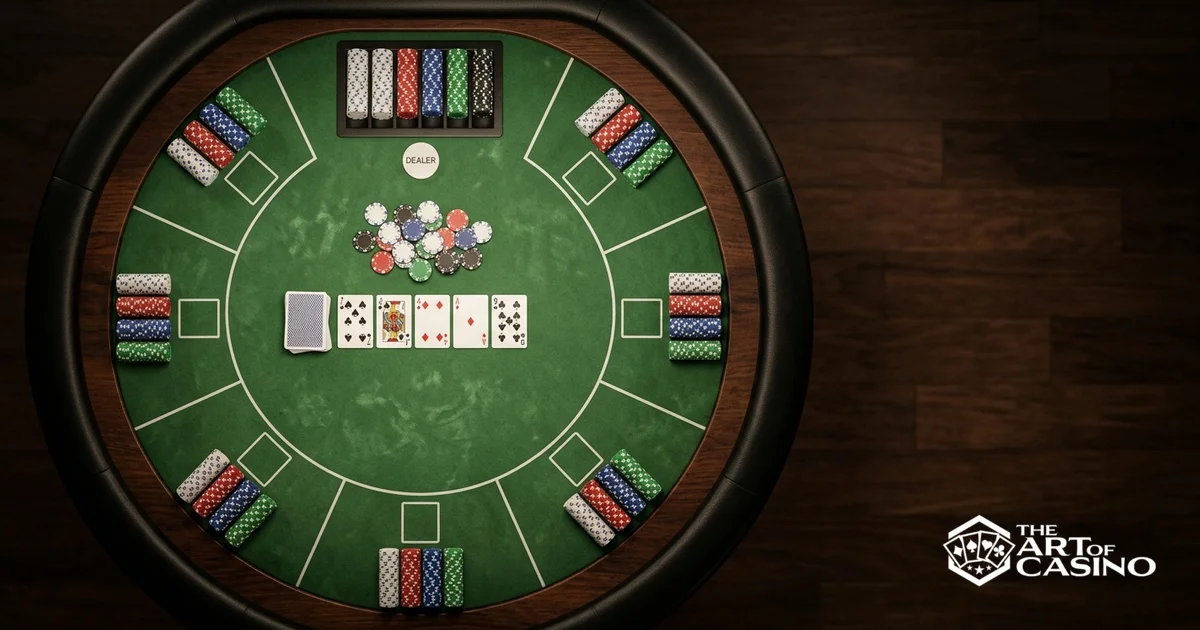
Position refers to when you act relative to other players. Acting later gives you more information, you see what opponents do before making your decision.
Position Names
Early Position (EP):
- Under the Gun (UTG): First to act preflop
- UTG+1, UTG+2: Next seats clockwise
- Must act with minimal information
- Play tightest from here
Middle Position (MP):
- Seats between early and late position
- More information, but not ideal
- Can open wider than EP
Late Position (LP):
- Cutoff (CO): One seat right of button
- Button (BTN): Best position at the table
- Maximum information before acting
Blinds:
- Small Blind (SB): Forced bet, acts first postflop
- Big Blind (BB): Larger forced bet, last preflop but early postflop
Why Position Matters
Information advantage: You see opponents' actions before deciding. Did they check (weak?), bet (strong?), or raise (very strong?).
Pot control: In position, you decide whether to bet for value, check for pot control, or bluff when checked to.
Bluffing opportunities: When opponents check to you, bluffs are more credible. Out of position, you're betting into unknown hands.
Value extraction: See opponents' responses before deciding how much to bet. Extract maximum value from strong hands.
Free cards: When checked to, you can take a free card to improve your draw.
Position Strategy Adjustments
Playing in Position (IP)
Preflop:
- Open wider from late position
- Call more speculative hands (suited connectors, small pairs)
- 3-bet lighter as a bluff
Postflop:
- Bet more frequently (opponents often give up)
- Float with draws (call, then bet when opponent gives up)
- Size bets based on opponent tendencies
- Control pot size when appropriate
Playing Out of Position (OOP)
Preflop:
- Open tighter ranges
- 3-bet more polarized (very strong or bluffs)
- Fold more marginal hands
Postflop:
- Check-raise more frequently (balance checking range)
- Lead less often (unless wet board texture favors you)
- Give up earlier on marginal hands
- Size bets for protection
Position-Based Opening Ranges
| Position | Approximate Open % |
|---|---|
| UTG | 12-15% |
| UTG+1 | 14-17% |
| MP | 16-20% |
| CO | 25-30% |
| BTN | 40-50% |
| SB | 35-45% |
These are guidelines, adjust based on table dynamics.
The Button Advantage
Why the Button Is Best
The button has position on everyone for the entire hand. Statistics show button players win the most money.
Button advantages:
- Last to act on every street
- Can steal blinds easily
- Sees all actions before deciding
- Controls pot size precisely
- Maximum bluffing credibility
Button Strategy
Opening range: Very wide (40-50% of hands)
Against one limper: Raise with almost any playable hand
Postflop: Use your position aggressively
Against 3-bets: Can call in position with wider range
Stealing Blinds
The button is prime stealing position:
- Raise with playable hands
- Many blinds fold to aggression
- Even when called, you have position
Blind stealing is a significant part of long-term poker profit.
Blind Play
Small Blind Strategy
The worst position at the table:
- Pay half a blind
- Out of position postflop against everyone except BB
- Must play carefully
Adjustments:
- Complete or fold most hands (raising only premium)
- Some players employ a 3-bet or fold strategy
- Never limp weak hands (just folds or raises)
- Be prepared to play defense postflop
Big Blind Strategy
Better than small blind but still challenging:
- Already invested one full blind
- Must defend against steals, but not too wide
- Out of position postflop against all but SB
Adjustments:
- Defend against button opens reasonably wide (price is good)
- 3-bet tighter than from other positions
- Fold to large early position opens
- Check-raise postflop to combat position disadvantage
Table Selection
Why Table Selection Matters
You can't beat tough tables as profitably as soft ones. The same skill level earns dramatically more at the right table.
Example:
- Table A: Six regulars, two fish. Win rate: 2bb/100 hands.
- Table B: Three regulars, five fish. Win rate: 8bb/100 hands.
Same player, four times the profit. Table selection is that powerful.
Identifying Good Tables
Signs of a soft table:
- Large average pots
- High flop percentage (players seeing many flops)
- Many limpers (passive, weak play)
- Visible recreational players (drinks, chatting, having fun)
- Frequent min-raises or strange bet sizes
- Players showing hands unnecessarily
Signs of a tough table:
- Small average pots
- Low flop percentage (tight play)
- Frequent 3-bets and 4-bets
- Players wearing hoodies/headphones (stereotypically serious)
- Professional demeanor
- Everyone on their phones with poker apps
Using Casino Information
Floor staff: Ask which tables are action-heavy. They know.
Wait list: Join multiple lists; choose the best available table.
Table change: Request a move if your table tightens up.
Game selection apps: Some tools track casino game quality.
Seat Selection
Once you find a good table, position matters:
Put recreational players on your right: You'll have position on them, the most profitable situation.
Put tight/aggressive players on your left: They'll act before you can exploit their patterns.
Avoid having big stacks directly on your left: They can put pressure on you postflop.
Table Changing
Don't stay at bad tables out of stubbornness:
- If the fish leave, consider leaving too
- If the table dynamics shift, adapt or move
- Your ego shouldn't keep you at a tough game
Online Table Selection
Finding Soft Games
Lobby statistics:
- VPIP (voluntarily put money in pot): Higher = looser = usually softer
- Players per flop: Similar metric
- Average pot size: Larger often means more action
Time of day: Recreational players often play nights and weekends.
Game type: Lower stakes often have more recreational players.
Multi-Tabling Considerations
More tables = more volume, but:
- Less time for player reads
- Reduced ability to table select
- May end up at tougher tables
Balance volume with game quality.
Tracking Software
HUD (Heads-Up Display) tools show:
- Opponent statistics
- Table profitability
- Historical results
Use data to identify soft tables and weak players.
Live vs. Online Table Selection
Live Advantages
More information:
- Physical tells
- Player behavior
- Table atmosphere
Better selection:
- Visually identify recreational players
- Chat with floor staff
- Observe before sitting
Stickier players:
- Players stay longer at live games
- Less table-hopping than online
Online Advantages
More options:
- Dozens of tables running simultaneously
- Easy to try different tables
Faster information:
- Lobby statistics available instantly
- Tracking software provides data
Easier to leave:
- No social pressure to stay
- Click a button and go
Common Mistakes
Position Mistakes
Playing too many hands OOP: Calling raises out of position with marginal hands is a huge leak.
Not exploiting the button: Tight button play leaves money on the table.
Ignoring position in bet sizing: Out of position, you often need to bet larger for protection.
Table Selection Mistakes
Ego over profit: Staying at tough games to prove yourself costs money.
Ignoring game dynamics: Tables change as players leave and join. Adjust.
Poor seat selection: Sitting anywhere available instead of strategically.
Playing tired/tilted: Poor mental state makes any table harder.
The Bottom Line
Position is the most underrated edge in poker. Playing more hands in position and fewer out of position immediately improves results.
Table selection might be even more impactful. The best player at a tough table makes less than an average player at a soft one. Swallow your pride and seek out profitable games.
To improve:
- Tighten early position, widen late position
- Steal more from the button
- Avoid marginal situations out of position
- Actively seek soft tables
- Change tables when games get tough
- Put recreational players on your right
These aren't glamorous skills, but they're where consistent profit comes from.