
Sports betting has exploded in popularity since legalization swept across the United States. If you're new to betting on sports, the terminology and numbers can seem overwhelming. This guide breaks down everything you need to know to place your first bet with confidence.
Is Sports Betting Legal Where You Are?
Before anything else, verify sports betting is legal in your state. As of 2026, over 35 states plus Washington D.C. have legalized sports betting, but rules vary:
- Some states allow online and in-person betting
- Some only allow in-person at casinos
- Some have restrictions on betting types or sports
Check your state's gaming commission website for current regulations.
Understanding Odds Formats
Odds tell you two things: the implied probability of an outcome and how much you'll win. American sportsbooks primarily use American odds, but you'll encounter other formats too.
American Odds (Moneyline)
The most common format in US sportsbooks.
Negative odds (-150):
- How much you must bet to win $100
- -150 means bet $150 to win $100
- Indicates the favorite
Positive odds (+200):
- How much you win on a $100 bet
- +200 means win $200 on a $100 bet
- Indicates the underdog
Even odds (-110 / +100):
- Close to a 50/50 proposition
- -110 is standard for point spread bets (the vig)
Converting Odds to Probability
| American Odds | Implied Probability |
|---|---|
| -200 | 66.7% |
| -150 | 60% |
| -110 | 52.4% |
| +100 | 50% |
| +150 | 40% |
| +200 | 33.3% |
Decimal Odds
Common in Europe and online:
- 2.50 means you get $2.50 back for every $1 bet (including your stake)
- Multiply your bet by the decimal to calculate total return
Fractional Odds
Traditional UK format:
- 5/2 means win $5 for every $2 bet
- Your stake is returned in addition to winnings
Types of Bets
Moneyline
The simplest bet: pick the winner.
Example:
- New York Yankees -150
- Boston Red Sox +130
Bet $150 on Yankees to win $100 (plus your stake back). Bet $100 on Red Sox to win $130 (plus your stake back).
When to use moneyline:
- When you're confident in a winner
- In low-scoring sports where margins are slim
- To avoid point spread complexity
Point Spread
Bet on the margin of victory, not just the winner.
Example:
- Kansas City Chiefs -7 (-110)
- Denver Broncos +7 (-110)
Chiefs must win by more than 7 points to "cover" the spread. Broncos can lose by up to 6 points and still "cover."
Key terms:
- "Cover" = win against the spread
- "Push" = land exactly on the spread (bet is refunded)
- "Hook" = half-point (7.5 eliminates pushes)
Totals (Over/Under)
Bet on combined points scored by both teams.
Example:
- Over 48.5 (-110)
- Under 48.5 (-110)
If the final score is 28-24 (52 total), the Over wins.
Strategy:
- Consider weather, pace of play, injuries
- Popular for casual bettors, no need to pick a winner
Parlays
Combine multiple bets into one ticket. All selections must win for the parlay to pay.
Example:
- Chiefs -7 (must cover)
- Lakers -5 (must cover)
- Yankees moneyline (must win)
Parlay payouts:
| Legs | Approximate Odds |
|---|---|
| 2 | +260 (3.6x) |
| 3 | +600 (7x) |
| 4 | +1200 (13x) |
| 5 | +2500 (26x) |
The catch: Parlays have higher house edge than straight bets. One loss kills the entire ticket.
Teasers
Like parlays but you adjust point spreads in your favor, reducing odds.
Example:
- Move Chiefs from -7 to -1
- Move Lakers from -5 to +1
- Both must cover adjusted spreads
Prop Bets
Bets on specific events within a game.
Player props:
- Patrick Mahomes over/under 275.5 passing yards
- LeBron James over/under 7.5 rebounds
Game props:
- First team to score
- Will there be overtime?
- Total touchdowns by either team
Props add fun but often have higher house edges.
Futures
Long-term bets on season or tournament outcomes.
Examples:
- Super Bowl winner
- MVP awards
- Division champions
- Win totals (over/under 10.5 wins)
Considerations:
- Money tied up for extended periods
- Injuries/trades can kill your bet
- Often better odds early in season
Placing Your First Bet
At a Casino Sportsbook
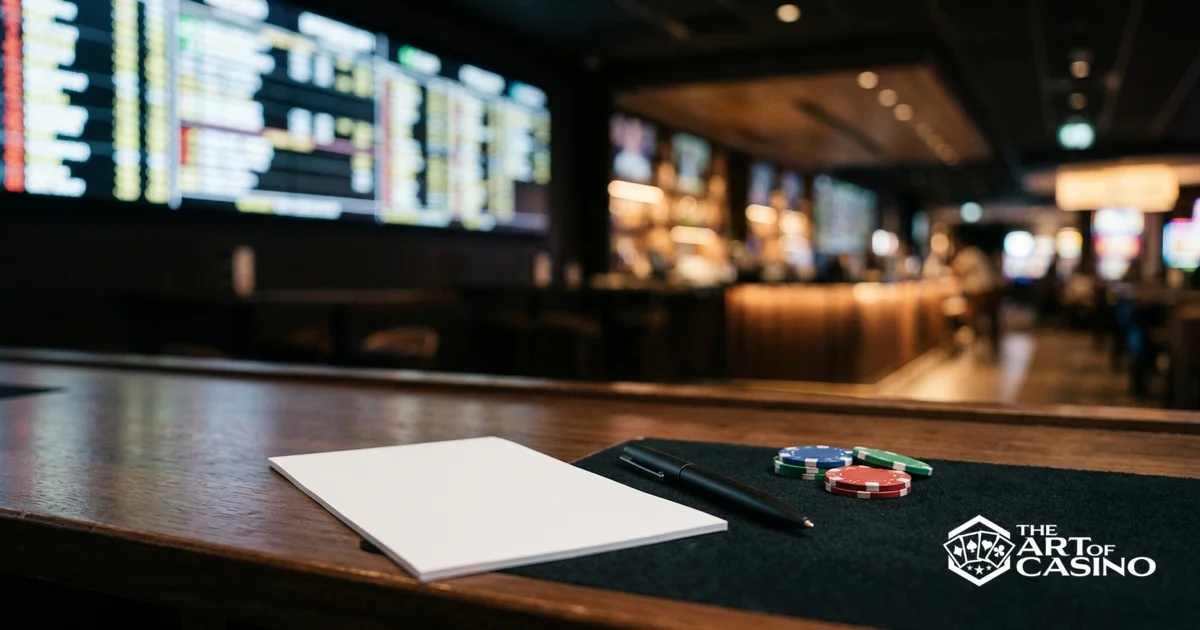
- Find the sportsbook: Usually a dedicated area with screens and seating
- Review the board: Large displays show current odds
- Decide your bet: Know the team, bet type, and amount before approaching
- Go to the window: Tell the ticket writer:
- Sport
- Team and bet type (e.g., "Chiefs minus 7")
- Amount
- Confirm and pay: Review the printed ticket before leaving
- Collect winnings: Return to the window with winning tickets
At Self-Service Kiosks
- Touch screen to start
- Select sport and game
- Choose bet type
- Enter amount
- Insert cash or ticket
- Collect your ticket
Mobile Apps (Where Legal)
- Download the sportsbook app
- Create account, verify identity
- Deposit funds (debit, bank transfer, PayPal, etc.)
- Navigate to your sport/game
- Tap your bet selection
- Enter amount in bet slip
- Confirm bet
- Winnings credited automatically
Reading the Betting Board
A typical sportsbook display shows:
ROT# | TEAM           | SPREAD | TOTAL | MONEYLINE
201  | KANSAS CITY    | -7     | O 48.5| -280
202  | DENVER         | +7     | U 48.5| +230
- ROT#: Rotation number (use this when betting at the window)
- Team: The team name
- Spread: Point spread (favorite shows -)
- Total: Combined score over/under
- Moneyline: Straight-up win odds
Key Terminology
| Term | Meaning |
|---|---|
| Action | A bet or wager |
| Chalk | The favorite |
| Dog | The underdog |
| Handle | Total amount wagered |
| Juice/Vig | The sportsbook's commission |
| Lock | A "sure thing" (they don't exist) |
| Sharp | Professional bettor |
| Square | Casual/recreational bettor |
| Unit | A standard bet size (yours to define) |
| Steam | Rapid line movement from heavy betting |
| Bad beat | Losing a bet in unexpected/painful fashion |
Bankroll Management for Sports Betting
Define a Unit Size
A "unit" is your standard bet size, typically 1-2% of your bankroll.
- $500 bankroll = $5-10 unit
- $1,000 bankroll = $10-20 unit
- $5,000 bankroll = $50-100 unit
Stick to Unit Betting
Resist the urge to chase losses with bigger bets. One or two unit bets protect your bankroll through losing streaks.
Track Everything
Keep records of every bet:
- Date, sport, teams
- Bet type and odds
- Stake and result
- Running profit/loss
This reveals your strengths, weaknesses, and actual performance.
Common Mistakes to Avoid
Betting with Your Heart
Betting on your favorite team feels good but often leads to biased analysis. Be objective or skip games involving teams you're emotional about.
Chasing Losses
Losing streaks happen to everyone. Doubling up to recover losses usually makes things worse.
Ignoring Bankroll Management
Bet sizing matters more than picking winners. A few big losing bets can wipe out many small wins.
Parlays as Strategy
Parlays are fun but have terrible expected value. Treat them as lottery tickets, not investment strategy.
Betting Without Research
"I have a feeling" isn't analysis. Consider injuries, matchups, weather, rest days, and motivation.
Understanding the Vig
The "vig" (vigorish) or "juice" is the sportsbook's commission.
Standard spread bet: -110 on each side
This means:
- Bet $110 to win $100
- If you win 50% of bets at -110, you lose money
- Need approximately 52.4% win rate to break even
The vig is why sports betting is hard. You're fighting an uphill mathematical battle on every bet.
Responsible Sports Betting
Set Limits
- Deposit limits on mobile apps
- Weekly/monthly betting budgets
- Time spent watching/researching
Warning Signs
- Betting money you can't afford to lose
- Chasing losses with bigger bets
- Lying about gambling
- Betting interfering with work/relationships
- Unable to stop when you planned to
Get Help
If betting becomes a problem, resources exist:
- National Council on Problem Gambling: 1-800-522-4700
- Most sportsbook apps have responsible gambling tools
- Self-exclusion programs available
The Bottom Line
Sports betting adds excitement to watching games, but approach it as entertainment with a cost, not a money-making strategy. Start small, learn bet types, track your results, and never bet more than you can afford to lose.
The goal isn't to get rich; it's to enjoy sports a little more while managing your risk responsibly.