

How to Play Pai Gow (Chinese Dominoes): Complete Guide
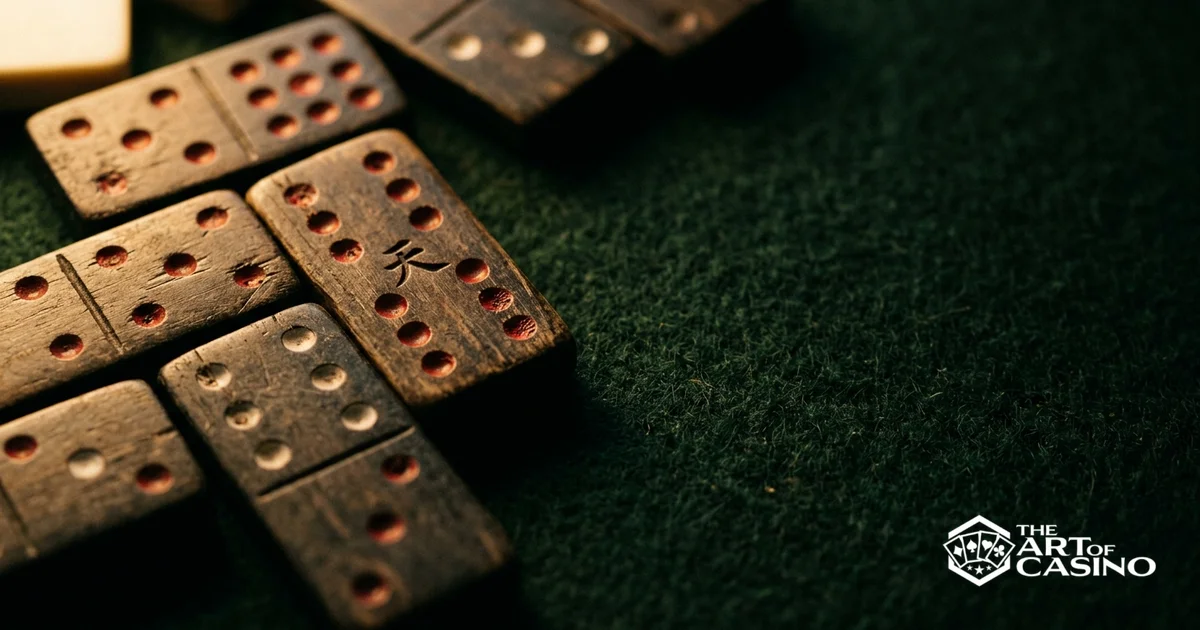
Pai Gow is an ancient Chinese domino game that has been played for centuries and remains a staple in many casinos, particularly those catering to Asian clientele. Using 32 dominoes (tiles), players create two hands and compete against the banker. With its complex tile rankings, deep strategic elements, and cultural significance, Pai Gow offers a unique casino experience unlike any card game.
This guide covers everything you need to understand Pai Gow: the tiles, hand rankings, setting strategy, and what to expect at the table.
Table of Contents
- What Is Pai Gow?
- The Tiles
- How to Play
- Hand Rankings
- Setting Your Hands
- Special Hands
- Strategy Basics
- Odds and House Edge
- Pai Gow Etiquette
- Frequently Asked Questions
- Conclusion
What Is Pai Gow?
Pai Gow (meaning "make nine" in Cantonese) is a Chinese gambling game played with a set of 32 dominoes. Players receive four tiles and must divide them into two hands, a "high" hand and a "low" hand. Both hands must beat the banker's corresponding hands to win.
History and Origins
Pai Gow dates back to the Song Dynasty in China (around 960-1279 AD), making it one of the oldest gambling games still played today. The game spread through Chinese communities worldwide and found its way into Western casinos in the 20th century.
Pai Gow vs. Pai Gow Poker
Do not confuse Pai Gow (tiles) with Pai Gow Poker (cards):
| Feature | Pai Gow (Tiles) | Pai Gow Poker |
|---|---|---|
| Equipment | 32 Chinese dominoes | 53-card deck |
| Complexity | Very high | Moderate |
| Learning curve | Steep | Gentle |
| Popularity | Asian markets | Worldwide |
Pai Gow Poker was created in 1985 as a card-based adaptation. This guide covers traditional Pai Gow with tiles.
Why Players Enjoy Pai Gow
Cultural tradition: For many Asian players, Pai Gow connects to heritage and tradition.
Strategic depth: The complex tile rankings and setting decisions appeal to serious gamblers.
Low volatility: Like Pai Gow Poker, many hands push, extending session time.
Social atmosphere: The ritualistic dealing and tile-handling create a distinctive experience.
The Tiles
Understanding the 32 tiles is fundamental to playing Pai Gow.
Tile Composition
The set consists of 32 tiles: 11 pairs (22 tiles) plus 10 non-pairing tiles.
The Eleven Pairs
Tiles come in two main categories: Day tiles and Night tiles.
High-Ranking Pairs (Days):
- Gee Joon (also called "Supreme"): [1-2] [1-2] - The highest pair
- Teen (Heaven): [1-6] [1-6]
- Day (Earth): [1-1] [1-1]
- Yun (Man): [4-4] [4-4]
- Gor (Goose): [1-3] [1-3]
- Mooy (Plum Flower): [5-5] [5-5]
- Chong (Long): [2-3] [2-3]
- Bon (Board): [5-6] [5-6]
Low-Ranking Pairs (Nights): 9. Fu (Axe): [5-4] [5-4] 10. Ping (Partition): [6-4] [6-4] 11. Tit (Long Leg Seven): [6-1] [6-1] 12. Look (Big Head Six): [6-1] - Note: This pairs with the [3-3] tile
Single Tiles
Ten tiles do not form pairs with identical tiles but may combine with other tiles for special hands. These include mixed pairs and unpaired tiles used in point calculations.
Tile Values
Each tile has a point value based on the total of its pips (dots), with only the last digit counting (like baccarat):
- [6-6] = 12 pips = 2 points
- [3-4] = 7 pips = 7 points
- [5-5] = 10 pips = 0 points
How to Play
Pai Gow follows a structured dealing and betting format.
The Setup
A standard Pai Gow table accommodates up to 8 positions (including the dealer/banker position). Each position receives four tiles.
Step-by-Step Gameplay
1. Place Your Bet Put chips in the betting area before tiles are dealt.
2. Tiles Are Shuffled and Stacked The dealer shuffles all 32 tiles and creates 8 stacks of 4 tiles each.
3. Determine Distribution Order The dealer shakes dice in a cup to determine which position receives tiles first.
4. Receive Your Tiles You receive 4 tiles face down.
5. Set Your Hands Arrange your 4 tiles into two hands:
- High hand: 2 tiles
- Low hand: 2 tiles
The high hand must outrank the low hand (in most cases).
6. Compare Against the Banker Your high hand vs. banker's high hand Your low hand vs. banker's low hand
7. Determine Results
- Win both: You win even money minus 5% commission
- Lose both: You lose your bet
- Split: Push (bet returned)
- Copies (ties): Banker wins
The Commission
Like Pai Gow Poker, winning bets pay 1:1 minus a 5% commission. This is how the house maintains its edge.
Hand Rankings
Pai Gow hand rankings are complex and require memorization.
Pair Rankings (Highest to Lowest)
- Gee Joon (Supreme): [1-2] + [1-2]
- Teen (Heaven): [1-6] + [1-6]
- Day (Earth): [1-1] + [1-1]
- Yun (Man): [4-4] + [4-4]
- Gor (Goose): [1-3] + [1-3]
- Mooy (Plum): [5-5] + [5-5]
- Chong (Long): [2-3] + [2-3]
- Bon (Board): [5-6] + [5-6]
- Fu (Axe): [5-4] + [5-4]
- Ping (Partition): [6-4] + [6-4]
- Tit (Long Leg): [6-1] + [6-1]
- Look (Big Head): [6-1] + [3-3]
Non-Pair Hand Rankings
When you don't have a pair, hand value is determined by:
- Wong (9 points with a Teen or Day tile)
- Gong (8 points with a Teen or Day tile)
- Point value (0-9, with 9 being highest)
Point Calculation
Add the pips of both tiles, take the last digit:
- [4-4] + [2-3] = 8 + 5 = 13 = 3 points
- [6-6] + [6-5] = 12 + 11 = 23 = 3 points
- [1-6] + [3-3] = 7 + 6 = 13 = 3 points
Special Rule: Gee Joon
The Gee Joon tiles ([1-2]) are wild and can count as either 3 or 6 points, whichever benefits your hand more.
Setting Your Hands
Dividing your four tiles optimally is the key skill in Pai Gow.
The Fundamental Rule
Your high hand should generally outrank your low hand. However, some special combinations break this rule (known as "minor/major" hands).
Setting Strategy Basics
With a Pair:
- Usually keep the pair together in one hand
- Use your best remaining tiles for the other hand
With No Pair:
- Balance your hands to give both chances of winning
- Avoid putting all strength in one hand
With Two Pairs:
- Usually split one pair to each hand
- Exception: If one pair is very high and you have strong single tiles
With Wong or Gong Potential:
- Teen or Day tiles with 8s or 9s can form Wong (9) or Gong (8)
- Often worth playing together for the special hand value
House Way
Many casinos have a "house way" for setting Pai Gow tiles. Unlike Pai Gow Poker, the house way for tiles is extremely complex and varies by casino. Experienced players typically develop their own strategy.
Special Hands
Certain tile combinations have special values that override normal point counting.
Wong (9 with Teen or Day)
When a Teen [1-6] or Day [1-1] tile combines with an 8-point tile, the hand is called "Wong" and ranks as 9 (but higher than a regular 9).
Examples:
- [1-6] + [4-4] = Wong
- [1-1] + [5-3] = Wong
Gong (8 with Teen or Day)
When a Teen or Day tile combines with a 9-point tile, the hand is called "Gong" and ranks as 8 (but higher than a regular 8).
Examples:
- [1-6] + [5-4] = Gong
- [1-1] + [6-3] = Gong
Ranking Order
- Pairs (highest to lowest as listed)
- Wong
- Gong
- 9 points
- 8 points
- 7 points
- ... down to 0 points
Strategy Basics
Pai Gow strategy requires understanding hand values and balancing your two hands.
General Principles
Balance is key: A 7-point hand and 5-point hand often beats 9 points and 2 points.
Know your pairs: Pair rankings must be memorized. A Gee Joon pair beats everything.
Use Gee Joon wisely: The wild [1-2] tiles offer flexibility. Calculate both values.
Consider the banker's likely hands: With 32 tiles distributed, you can sometimes deduce possibilities.
Common Decisions
High pair, weak singles: Keep the pair together. Your pair likely wins its comparison even if the other hand is weak.
Medium tiles, no pairs: Balance carefully. Two decent hands beat one strong and one hopeless.
Teen or Day tile: Look for Wong or Gong opportunities. These special hands often determine outcomes.
When to Bank
Like Pai Gow Poker, banking shifts the copy rule in your favor and reduces the house edge. Bank when:
- Your bankroll can handle variance
- The casino offers banking rotations
- You have a strong understanding of strategy
Odds and House Edge
Pai Gow offers competitive odds for players who understand the game.
House Edge
Standard play: 2.5-2.8% (similar to Pai Gow Poker)
With banking: Can be reduced significantly
Outcome Distribution
| Outcome | Approximate Probability |
|---|---|
| Player wins both | 28-29% |
| Banker wins both | 30-31% |
| Push (split) | 40-42% |
Why Volatility Is Low
The high push rate (around 41%) means:
- Bankroll swings are smaller
- Sessions last longer
- Expected loss per hour is modest despite the house edge
Pai Gow Etiquette
Traditional Pai Gow carries cultural significance and customs.
Tile Handling
- Handle tiles respectfully
- Do not slam tiles on the table
- Keep tiles below table edge level (no flashing to others)
- Some players consider certain handling unlucky
Dice Rituals
- The dice cup ceremony has cultural meaning
- Don't rush the dealer during dice shaking
- Some players have preferences about dice results
Dealing Customs
- The tile distribution follows a specific pattern
- Don't touch stacks meant for other positions
- Wait for all tiles to be distributed before looking at yours
Banking Etiquette
- Announce banking intention clearly
- Have sufficient chips visible
- Accept losses gracefully when banking
Superstitions
Many Pai Gow players follow superstitions:
- Lucky seating positions
- Preferences for certain tile stacks
- Rituals before looking at tiles
Respect others' beliefs even if you don't share them.
Frequently Asked Questions
Conclusion
Pai Gow is an ancient game offering strategic depth, cultural richness, and favorable odds. The 32 tiles, complex rankings, and setting decisions create a unique challenge that rewards study and practice.
Key takeaways:
- House edge: approximately 2.5-2.8%
- Push rate: approximately 40%+
- Learning curve: Steep (tile rankings require memorization)
- Best for: Players seeking cultural experience and strategic depth
For new players:
- Start with Pai Gow Poker to learn the hand-setting concept
- Study tile rankings before playing for real money
- Accept that mastery takes significant time
- Find a table with patient dealers
For experienced players:
- Bank when possible to reduce house edge
- Master tile combinations and special hands
- Appreciate the game's cultural heritage
Pai Gow connects modern casino gambling with centuries of Asian gaming tradition. For those willing to invest time in learning, it offers one of the most rewarding and distinctive table game experiences available.
Good luck at the tiles.
Other Specialty Games Games
Explore the players and pioneers who shaped casino gaming in our Hall of Fame.