
Dealing requires quick, accurate mental math. Calculating payouts, making change, and handling bets all happen under time pressure with money on the line.
The good news: dealing math is learnable. With practice, the calculations become automatic. This guide covers the essential math skills for each major table game.
Core Math Skills
Mental Arithmetic Foundation
What's required:
- Addition and subtraction of multiple numbers
- Multiplication by common factors (2, 3, 1.5)
- Division for splits and change
- Working with 5s, 10s, 25s, and 100s
What's not required:
- Complex algebra
- Statistics theory
- Calculator-level precision for odd numbers
The reality: Most dealing math involves common bet sizes and standard payouts. Patterns emerge quickly.
Chip Denomination Fluency
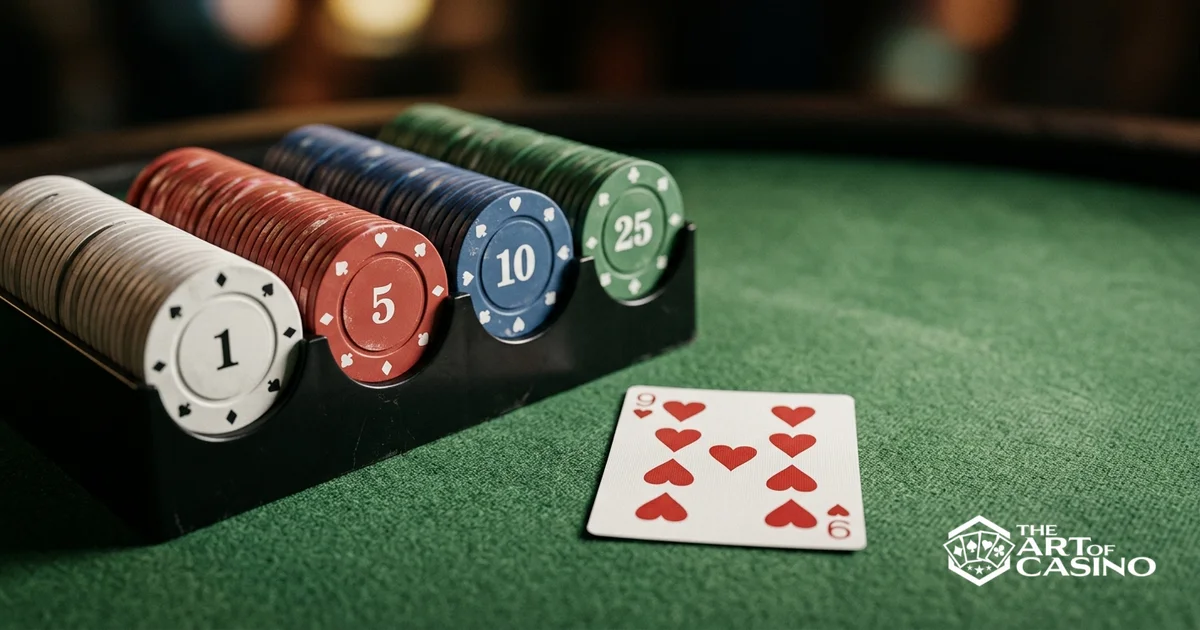
Standard denominations:
- $1 (white/blue)
- $5 (red)
- $25 (green)
- $100 (black)
- $500 (purple)
- $1000+ (varies by property)
Chip counting: Quick visual counting of chip stacks:
- Standard stack = 20 chips
- Counting by color rather than individual chips
- Breaking larger stacks into countable groups
Color changes: Converting between denominations quickly:
- 5 reds = 1 green ($25)
- 4 greens = 1 black ($100)
- 5 blacks = 1 purple ($500)
Payout Principles
Even money (1:1): Pay the bet amount. $25 bet = $25 win.
3:2 payouts: Multiply by 1.5. $10 bet = $15 win. $25 bet = $37.50 win.
2:1 payouts: Double the bet. $25 bet = $50 win.
Fractional payouts: Break into components. For 6:5, multiply by 6/5 (or 1.2).
Blackjack Math
Standard Payouts
Blackjack (3:2): The most common calculation dealers make.
Common amounts:
- $5 bet = $7.50
- $10 bet = $15
- $15 bet = $22.50
- $25 bet = $37.50
- $50 bet = $75
- $100 bet = $150
Quick method: Divide bet by 2, add to original bet. $25 ÷ 2 = $12.50, plus $25 = $37.50
6:5 blackjack: Multiply by 1.2. $25 bet = $30 win. Easier math, worse for players.
Insurance and Even Money
Insurance (2:1): Insurance bet is half the original bet. Pay double if dealer has blackjack.
$20 bet → $10 insurance → $20 insurance payout (if dealer BJ)
Even money: When player has blackjack and dealer shows ace, pay 1:1 on original bet instead of risking with insurance.
Split and Double Math
Splitting: Each split hand is bet separately at original amount.
Doubling: Original bet doubled, then either 1:1 win or loss on doubled amount.
Making Change
Common scenarios:
- Player puts $100 bill in betting circle, wants smaller bet
- Player wins and wants to color up
- Converting green to red for specific bet amount
Clean transactions: Push payment with one hand, collect with other. Keep transactions visible.
Craps Math
Basic Payouts
Pass/Don't Pass: Even money (1:1).
Come/Don't Come: Even money (1:1).
Odds bets: True odds, varies by point number:
- 4 and 10: 2:1 ($10 pays $20)
- 5 and 9: 3:2 ($10 pays $15)
- 6 and 8: 6:5 ($10 pays $12)
Place Bet Payouts
Place 6 or 8: 7:6 $6 bet = $7 win $12 bet = $14 win $30 bet = $35 win
Place 5 or 9: 7:5 $5 bet = $7 win $10 bet = $14 win $25 bet = $35 win
Place 4 or 10: 9:5 $5 bet = $9 win $10 bet = $18 win $25 bet = $45 win
Proposition Bets
Hardways:
- Hard 6/8: 9:1
- Hard 4/10: 7:1
One-roll propositions:
- Any 7: 4:1
- Any craps: 7:1
- 2 or 12: 30:1
- 3 or 11: 15:1
The Challenge
Craps involves multiple simultaneous bets with different payouts. Dealers must track several calculations at once while the game continues.
Strategy: Master one bet type at a time. Place bets are most common; start there.
Roulette Math
Inside Bet Payouts
Straight up (single number): 35:1 $1 bet = $35 + original $1 = $36 total
Split (2 numbers): 17:1 $1 bet = $17 + original = $18 total
Street (3 numbers): 11:1 $1 bet = $11 + original = $12 total
Corner (4 numbers): 8:1 $1 bet = $8 + original = $9 total
Line (6 numbers): 5:1 $1 bet = $5 + original = $6 total
Outside Bet Payouts
Red/Black, Odd/Even, High/Low: 1:1 Dozens, Columns: 2:1
Multi-Chip Calculations
Roulette players often have multiple winning bets across the layout.
Approach:
- Calculate each bet separately
- Total all payouts
- Cut chips for total payout
Common patterns: Players often bet patterns. Recognizing common patterns speeds calculations.
Color (Roulette Chip) Management
Unique to roulette: Each player gets different colored chips worth their designated amount.
Tracking: Remember each player's chip value. Use lammers or markers to indicate values.
Baccarat Math
Simple Structure
Player bet: 1:1 Banker bet: 1:1 minus 5% commission Tie: 8:1 or 9:1 (varies)
Commission Calculations
5% of win:
- $100 win = $5 commission → $95 net payout
- $500 win = $25 commission → $475 net payout
Running commission: Some games track commission and collect at shoe end. Running totals required.
Commission-free baccarat: No commission on banker, but reduced payout on banker 6 win (typically 50%).
Side Bet Payouts
Various side bets exist with different paytables. Learn the specific paytable for your property.
Carnival Game Math
Three Card Poker
Ante bonus payouts:
- Straight flush: 5:1
- Three of a kind: 4:1
- Straight: 1:1
Pair Plus payouts:
- Mini royal: 100:1
- Straight flush: 40:1
- Three of a kind: 30:1
- Straight: 6:1
- Flush: 4:1
- Pair: 1:1
Let It Ride
Paytable varies by property:
- Royal flush: 1000:1 (or progressive)
- Straight flush: 200:1
- Four of a kind: 50:1
- Full house: 11:1
- Flush: 8:1
- Straight: 5:1
- Three of a kind: 3:1
- Two pair: 2:1
- Tens or better: 1:1
Learning Approach
Carnival games have fixed paytables. Memorize the specific table for each game at your property.
Developing Speed
Practice Methods
Flash cards: Practice common payout calculations until automatic.
Verbal drills: Say bet amounts, calculate payout, speak answer. Builds speed.
Practice dealing: Simulate games with practice chips. Time your calculations.
Pattern Recognition
Common bet sizes: Most bets cluster around standard amounts ($5, $10, $15, $25, $50, $100). Master these first.
Recurring combinations: Certain bet combinations appear repeatedly. Recognize patterns rather than calculating fresh.
Error Prevention
Double-checking: Develop quick verification habits without slowing pace.
Physical counting: Counting chip stacks as you build them catches arithmetic errors.
Suspicious results: Develop intuition for when results "feel wrong" and deserve verification.
Handling Complex Situations
Multiple Simultaneous Bets
Craps approach: Work systematically around the layout. Don't try to hold everything in memory.
Roulette approach: Calculate inside bets first, then outside. Total as you go.
Unusual Amounts
Odd bets: Break into components. $17 = $15 + $2. Calculate each part.
Large bets: Use multiplication relationships. $375 at 3:2 = $375 + $187.50 = $562.50.
Mistakes
When you make errors: Acknowledge, correct, continue. Don't let errors cascade.
Surveillance backup: Cameras catch discrepancies. Honest mistakes are corrected; patterns of errors are investigated.
Game-Specific Tips
Blackjack Focus
Master 3:2 payouts for common amounts. Everything else is simple 1:1.
Craps Focus
Place bets (6:5, 7:5, 9:5) are most challenging. Odds payouts follow patterns based on point.
Roulette Focus
Inside bet payouts are straightforward but must be quick with multiple winning numbers.
Baccarat Focus
Simple payouts, but commission tracking requires attention.
Frequently Asked Questions
Do I need to be good at math?
You need comfort with basic arithmetic: addition, subtraction, and multiplication by simple numbers. Complex math isn't required. The calculations are learnable through practice.
How do I get faster at payouts?
Practice. Flash cards for common amounts, verbal drills, and practice dealing all build speed. The calculations become automatic with repetition.
What if I make a calculation error?
Correct it as soon as noticed. Surveillance records everything. Honest mistakes are corrected; the key is accuracy, not perfection. Consistent errors, however, will be addressed.
Is craps math harder than other games?
Craps has more varied payouts than blackjack, which uses mostly 1:1 and 3:2. However, the calculations are still simple. The challenge is tracking multiple bets simultaneously.
Can I use a calculator?
Never on the floor. All calculations must be mental. Dealer school trains this skill; floor experience reinforces it.
Conclusion
Dealing math is a learnable skill. The calculations are not complex, they're repetitive applications of basic arithmetic. Speed comes from practice and pattern recognition.
Master the common calculations first. Less frequent situations can be worked through more carefully. Over time, even complex multi-bet scenarios become manageable.
The math shouldn't be intimidating. Anyone comfortable with basic arithmetic can develop dealing-level calculation speed with dedicated practice.
- How to Become a Casino Dealer - Complete career guide
- Casino Dealer School Guide - Training options