
Carnival games, proprietary table games with trademarked rules, fill modern casino floors. These games are generally simpler than traditional table games but require knowing specific procedures and paytables.
This guide covers dealing procedures for the most common carnival games.
Three Card Poker
Game Overview
Structure: Players make three-card hands competing against the dealer.
Bet types:
- Ante: Required to play against dealer
- Play: Must equal ante to continue
- Pair Plus: Bonus bet for pair or better (independent of dealer)
Dealing Procedure
Step 1: Collect Ante and optional Pair Plus bets.
Step 2: Deal three cards to each player, face down.
Step 3: Deal three cards to dealer, face down.
Step 4: Players examine cards, decide to fold or play.
- Fold: Lose ante (and Pair Plus if applicable)
- Play: Match ante with Play bet
Step 5: After all decisions, reveal dealer cards.
Step 6: Determine if dealer qualifies (Queen-high or better).
Step 7: Resolve hands.
Qualification
Dealer qualifies: Queen-high or better.
Does not qualify:
- Ante pushes (returned)
- Play bet wins 1:1
- Pair Plus still resolved normally
Payouts
Ante/Play vs. dealer:
- Beat dealer: 1:1 on both bets
- Lose to dealer: Lose both bets
- Tie: Push
Ante Bonus (when you beat dealer):
- Straight flush: 5:1 on ante
- Three of a kind: 4:1 on ante
- Straight: 1:1 on ante
Pair Plus (independent): Property-specific paytable. Common version:
- Mini royal (AKQ suited): 100:1
- Straight flush: 40:1
- Three of a kind: 30:1
- Straight: 6:1
- Flush: 4:1
- Pair: 1:1
Hand Rankings
Standard poker rankings but three cards only:
- Straight flush
- Three of a kind
- Straight
- Flush
- Pair
- High card
Note: Three of a kind beats straight in Three Card Poker.
Let It Ride
Game Overview
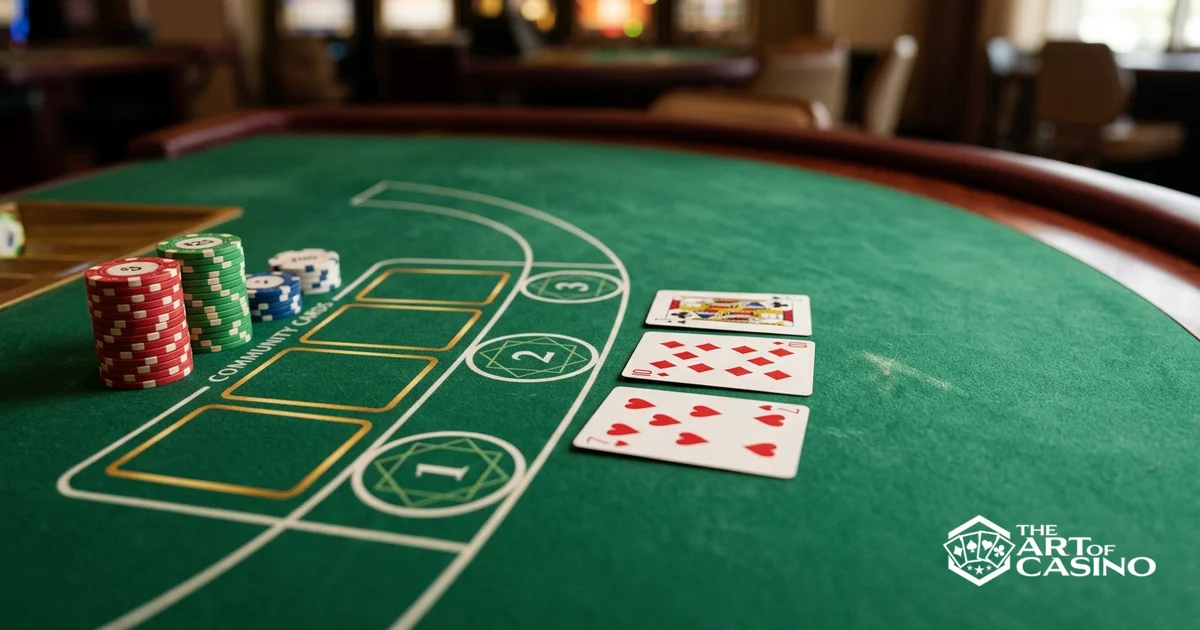
Structure: Players receive three cards; two community cards revealed sequentially.
Betting: Three equal bets placed. Players may withdraw bets or "let it ride."
Dealing Procedure
Step 1: Collect three equal bets (circles 1, 2, and 3 or $, $$, $$$).
Step 2: Deal three cards to each player, face down.
Step 3: Deal two community cards, face down, in center.
Step 4: Players examine cards, decide on bet 1:
- Withdraw first bet (pull back)
- Let it ride (leave it)
Step 5: Reveal first community card.
Step 6: Players decide on bet 2:
- Withdraw second bet
- Let it ride
Step 7: Reveal second community card.
Step 8: Resolve final hands (third bet always plays).
Bet Withdrawal
Motion: Players signal withdrawal with scratch motion toward themselves.
Let it ride: Players place cards under their bet or make "stay" motion.
Clarification: If unclear, verbally confirm player's decision.
Payouts
Based on final five-card hand (three player cards plus two community):
Standard paytable:
- Royal flush: 1000:1 (or progressive)
- Straight flush: 200:1
- Four of a kind: 50:1
- Full house: 11:1
- Flush: 8:1
- Straight: 5:1
- Three of a kind: 3:1
- Two pair: 2:1
- Tens or better: 1:1
- Less than tens: Lose
Payment: Each remaining bet paid separately at table odds.
Mississippi Stud
Game Overview
Structure: Similar to Let It Ride but escalating bets rather than withdrawing.
Player choice: After seeing cards, bet 1x, 2x, or 3x ante.
Dealing Procedure
Step 1: Collect ante bet.
Step 2: Deal two cards to each player, face down.
Step 3: Deal three community cards, face down, in center.
Step 4: Players examine cards, make first bet:
- Fold (lose ante)
- Bet 1x, 2x, or 3x ante
Step 5: Reveal first community card.
Step 6: Players make second bet:
- Fold (lose all previous bets)
- Bet 1x, 2x, or 3x ante
Step 7: Reveal second community card.
Step 8: Players make third bet (or fold).
Step 9: Reveal third community card.
Step 10: Resolve final five-card hands.
Payouts
Based on final hand against paytable:
Standard paytable:
- Royal flush: 500:1
- Straight flush: 100:1
- Four of a kind: 40:1
- Full house: 10:1
- Flush: 6:1
- Straight: 4:1
- Three of a kind: 3:1
- Two pair: 2:1
- Jacks or better: 1:1
- 6s to 10s: Push
- All other: Lose
Note: Each bet (ante plus all additional bets) paid at table odds.
Pai Gow Poker
Game Overview
Structure: Seven cards split into five-card and two-card hands.
Objective: Beat dealer's both hands to win; split equals push.
Dealing Procedure
Step 1: Collect bets.
Step 2: Shuffle or use shuffler.
Step 3: Deal seven cards to each position including dealer.
Step 4: Players set hands:
- Five-card "high" hand
- Two-card "low" hand
- High hand must outrank low hand
Step 5: Dealer sets house hand per house way.
Step 6: Compare hands:
- Win both: Player wins
- Lose both: Player loses
- Split: Push
Setting Hands
Player responsibility: Players set their own hands.
Invalid set: If low hand beats high hand, hand fouls (automatically loses).
Dealer setting: Follow the "house way" chart exactly.
Commission
Standard: 5% commission on winning bets.
Tracking: Take commission at time of payout.
Banking Option
Player bank: Some tables allow players to bank.
Procedure: Banker plays against all other players and dealer.
Commission: Casino takes commission on net win.
Ultimate Texas Hold'em
Game Overview
Structure: Hold'em-style game against dealer with multiple betting rounds.
Betting: Ante, blind, and optional Trips side bet.
Dealing Procedure
Step 1: Collect Ante and Blind bets (equal amounts). Optional Trips bet.
Step 2: Deal two cards to each player and dealer, face down.
Step 3: Players examine cards, first betting decision:
- Check (bet nothing)
- Bet 3x or 4x the ante (Play bet)
Step 4: Deal flop (three community cards).
Step 5: If no Play bet yet, second decision:
- Check
- Bet 2x ante
Step 6: Deal turn and river (two more community cards).
Step 7: If no Play bet yet, final decision:
- Fold (lose Ante and Blind)
- Bet 1x ante
Step 8: Reveal dealer hand.
Step 9: Dealer qualifies with pair or better.
Step 10: Resolve hands.
Qualification
Dealer qualifies: Pair or better.
Does not qualify:
- Ante pushes
- Play bet wins 1:1
- Blind pays per paytable if player wins
Blind Payouts (When Player Wins)
- Royal flush: 500:1
- Straight flush: 50:1
- Four of a kind: 10:1
- Full house: 3:1
- Flush: 3:2
- Straight: 1:1
- All other: Push
Trips Side Bet
Independent of dealer hand:
- Royal flush: 50:1
- Straight flush: 40:1
- Four of a kind: 30:1
- Full house: 8:1
- Flush: 7:1
- Straight: 4:1
- Three of a kind: 3:1
Four Card Poker
Game Overview
Structure: Similar to Three Card Poker but with four cards.
Key difference: Players get five cards, make best four-card hand.
Dealing Procedure
Step 1: Collect Ante and optional Aces Up bets.
Step 2: Deal five cards to each player, face down.
Step 3: Deal six cards to dealer, face down.
Step 4: Players select four cards for hand, discard one.
Step 5: Betting decision:
- Fold (lose ante)
- Play 1x to 3x ante
Step 6: Reveal dealer best four.
Step 7: Compare hands.
Qualification
Dealer always qualifies (no minimum hand required).
Payouts
Ante bonus (paid regardless of outcome):
- Four of a kind: 25:1
- Straight flush: 20:1
- Three of a kind: 2:1
Play bet vs. dealer: 1:1 on wins
Aces Up: Based on player hand regardless of dealer.
General Procedures
Common to All Carnival Games
Bet collection: Verify all bets placed before dealing.
Card handling: Deal face down, allow examination time.
Decision pace: Allow reasonable time but keep game moving.
Payout accuracy: Know paytables; verify before pushing.
Side Bet Handling
Independence: Most side bets resolve independently of main game.
Pay first: Often pay side bets before main game resolution.
Paytables: Property-specific, memorize your table's specific paytables.
Game Protection
Late bets: No bets after cards dealt.
Premature exposure: Keep cards secure until proper reveal.
Collusion: Watch for information sharing between players.
Frequently Asked Questions
Are carnival games easier than blackjack?
Procedurally, most carnival games are simpler than blackjack, fewer player decisions, fixed paytables. The challenge is memorizing multiple paytables if dealing mixed carnival pits.
How many carnival games do I need to know?
Depends on the property. Some require all games for mixed pit rotation. Others allow specialization. Three Card Poker is the most universally useful.
What if I don't know the paytable?
Keep a reference card until memorized. Properties usually provide paytable cards. Never guess, verify before paying.
Do carnival games pay well?
Comparable to blackjack tips. No significant premium, but busy carnival pits with bonus bets can generate good tokes when players hit.
Additional Resources
- Working as a Carnival Games Dealer - Career perspective
- How to Become a Casino Dealer - Complete career guide
- Three Card Poker Rules - Player-focused rules