

How to Play Craps: Rules, Bets, Odds, and Strategy Guide
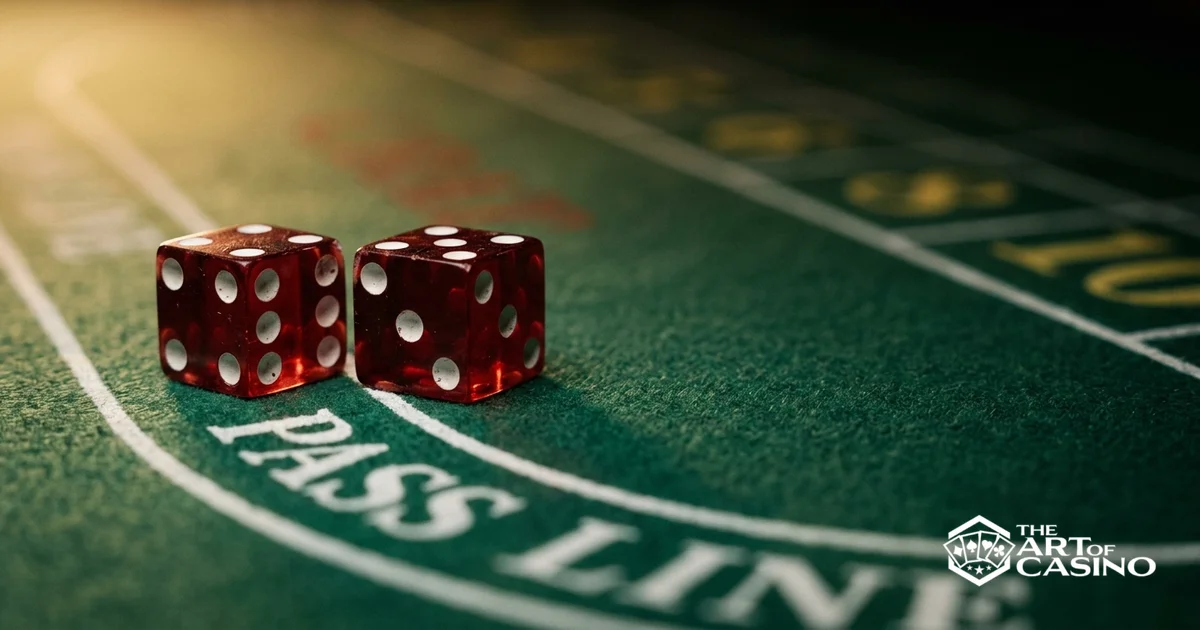
Craps is the most exciting game in the casino. The energy around a hot craps table is unlike anything else, players cheering together, high-fiving strangers, riding waves of momentum that feel almost magical. It is also one of the most intimidating games for newcomers, with a complex-looking layout and dozens of betting options.
This guide cuts through the confusion. You will learn exactly how craps works, which bets to make (and which to avoid), and how to join the action confidently. The game is simpler than it appears, and the best bets offer some of the lowest house edges in the casino.
Table of Contents
- What Is Craps?
- Quick Start Guide
- The Basics: Pass Line Betting
- The Point and How Games Progress
- All Craps Bets Explained
- Odds and Payouts
- Craps Strategy
- Table Etiquette
- Common Mistakes
- Frequently Asked Questions
- Conclusion
What Is Craps?
Craps is a dice game where players bet on the outcome of rolls. One player (the "shooter") throws two dice, and everyone at the table can bet on what numbers will appear. The game revolves around a core bet called the "pass line" and whether the shooter makes their "point" before rolling a 7.
Why Craps Is Special
Several factors make craps unique in the casino:
Community Experience: Unlike most casino games where you play against the house alone, craps creates a shared experience. Most players bet the same way, so the table wins and loses together. Strangers become temporary teammates, celebrating good rolls and commiserating over bad ones.
Best Odds Available: The pass line bet with full odds has no house edge on the odds portion, it is the only truly "fair" bet in the casino. Combined with the low 1.41% edge on the pass line itself, craps offers better mathematical expectations than almost any other game.
Shooter Control: You get to throw the dice yourself. While this does not actually change the odds (dice are random), the physical involvement adds engagement and a sense of agency.
Pace and Energy: A good craps roll can last 20 or 30 minutes, building excitement with every throw. The cheering, the superstitions, the collective anticipation, nothing else compares.
The Intimidation Factor
New players often avoid craps because the table looks complicated. The layout is covered in betting areas, and experienced players seem to speak a foreign language of "yo-eleven," "hard ways," and "press it."
Here is the truth: you can play craps using only one or two bets and completely ignore 90% of the table. The complex bets exist for variety and higher house edge profits, they are not required. Start simple, and add complexity only if you want to.
Quick Start Guide
If you want to play craps within the next ten minutes, here is exactly what to do.
What You Need to Know
- There is one main bet: the Pass Line
- You are betting that the shooter will win
- The shooter wins by rolling 7 or 11 on the first roll, OR by rolling their "point" again before rolling a 7
How to Play (Absolute Minimum)
- Wait for a new game to start (the dealer will say "coming out")
- Place chips on the "Pass Line" area in front of you
- The shooter rolls the dice
- If they roll 7 or 11, you win even money. Game over, new game starts.
- If they roll 2, 3, or 12, you lose. Game over, new game starts.
- If they roll 4, 5, 6, 8, 9, or 10, that number becomes the "point"
- The shooter keeps rolling until they either hit the point (you win) or roll a 7 (you lose)
That is literally all you need to know. The pass line has a 1.41% house edge, which is excellent. You can play all night with just this bet.
The One Addition You Should Make
Once a point is established, you can place an additional bet called "odds." This bet has zero house edge and pays true odds. Place it directly behind your pass line bet.
The amount you can bet on odds varies by casino (common limits are 3x, 5x, or 10x your pass line bet). Bet the maximum you are comfortable with, it is the best bet in the casino.
The Basics: Pass Line Betting
The pass line is the foundation of craps. Understanding it completely makes everything else click into place.
The Come-Out Roll
Every craps game begins with a "come-out roll." This is the first roll of a new game. Before this roll, pass line bettors are hoping for:
- 7 or 11: Instant win, pays even money
- 2, 3, or 12 (craps): Instant loss
- 4, 5, 6, 8, 9, or 10: No instant decision, this number becomes "the point"
Establishing the Point
If the come-out roll is 4, 5, 6, 8, 9, or 10, that number becomes the point. The dealer places a puck (marked "ON") on that number to remind everyone what the point is.
Now the game objective changes. The shooter keeps rolling, and pass line bettors win if the shooter rolls the point again before rolling a 7.
Resolving the Pass Line Bet
You Win If:
- Come-out roll is 7 or 11 (instant win)
- Shooter rolls the point before rolling a 7
You Lose If:
- Come-out roll is 2, 3, or 12 (instant loss)
- Shooter rolls a 7 before rolling the point (called "sevening out")
When the pass line bet resolves, win or lose, the game ends and a new come-out roll begins.
Pass Line Odds
Once a point is established, you can add an "odds bet" behind your pass line bet. This is the most important concept in craps.
The odds bet has zero house edge. It pays true mathematical odds based on the probability of rolling the point versus rolling a 7.
| Point | True Odds | Probability |
|---|---|---|
| 4 or 10 | 2:1 | 33.3% |
| 5 or 9 | 3:2 | 40.0% |
| 6 or 8 | 6:5 | 45.5% |
Example: If the point is 6 and you have $10 on the pass line, you can add odds. With 3x odds ($30), if the shooter makes the point, you win $10 on the pass line plus $36 on the odds (6:5 payout).
Always take maximum odds. This reduces the overall house edge on your combined bet significantly.
The Point and How Games Progress
Understanding the flow of a craps game helps you follow the action and bet at the right times.
Phase 1: Come-Out Roll
The puck shows "OFF" (black side up). The shooter is about to establish a point or resolve pass/don't pass bets immediately.
Possible outcomes:
- 7 or 11: Pass wins, don't pass loses, new come-out roll
- 2, 3, or 12: Pass loses, don't pass wins (or pushes on 12), new come-out roll
- 4, 5, 6, 8, 9, 10: This becomes the point, move to Phase 2
Phase 2: Point Established
The puck shows "ON" (white side up) and sits on the point number. The shooter is trying to roll the point again before rolling a 7.
Possible outcomes:
- Point number: Pass wins, don't pass loses, return to Phase 1
- 7 (seven-out): Pass loses, don't pass wins, shooter passes dice, return to Phase 1
- Any other number: No effect on pass line, game continues
When Can You Bet?
Pass Line: Only bet on the come-out roll. Once a point is established, do not add to your pass line bet (you can add odds, but not more on the pass line itself).
Odds: Only bet after a point is established. You can add, remove, or change your odds at any time.
Come Bets: Can be placed any time after a point is established.
Place Bets: Can be placed any time, but are typically made after a point is established.
All Craps Bets Explained
Craps offers more betting options than any other table game. They range from excellent (pass/don't pass with odds) to terrible (any seven). Learn what each bet does and its house edge.
The Good Bets (Low House Edge)
Pass Line, House Edge: 1.41% Bet that the shooter will win. Wins on come-out 7/11, loses on 2/3/12, otherwise wins if point is made before 7.
Don't Pass, House Edge: 1.36% Bet against the shooter. Opposite of pass line, wins on come-out 2/3 (12 is push), loses on 7/11, otherwise wins if 7 comes before point. Slightly better odds but socially unpopular.
Come Bet, House Edge: 1.41% Same as pass line but made after a point is established. Your come bet gets its own point based on the next roll.
Don't Come, House Edge: 1.36% Same as don't pass but made after a point is established.
Pass/Come Odds, House Edge: 0% Additional bet behind pass or come. Pays true odds with no house edge. The best bet in any casino.
Don't Pass/Come Odds (Laying Odds), House Edge: 0% Same as regular odds but for don't bettors. You lay more to win less at true odds.
The Mediocre Bets
Place 6 or 8, House Edge: 1.52% Bet that 6 (or 8) will roll before 7. Pays 7:6. Decent bet if you want action on specific numbers.
Place 5 or 9, House Edge: 4.00% Bet that 5 (or 9) will roll before 7. Pays 7:5. House edge getting uncomfortable.
Place 4 or 10, House Edge: 6.67% Bet that 4 (or 10) will roll before 7. Pays 9:5. Poor value.
Field Bet, House Edge: 2.78% to 5.56% One-roll bet that 2, 3, 4, 9, 10, 11, or 12 will appear. Pays even money except 2 and 12 pay double (sometimes triple for 12). House edge varies by casino rules.
Big 6/Big 8, House Edge: 9.09% Bet that 6 (or 8) will roll before 7. Pays even money. This is a sucker bet, place 6 or 8 instead for better odds.
The Bad Bets (High House Edge)
Hardways (Hard 4, 6, 8, 10), House Edge: 9.09% to 11.11% Bet that the specific double (2-2, 3-3, 4-4, 5-5) will appear before 7 or the easy way. Long odds, high house edge.
Any Craps, House Edge: 11.11% One-roll bet that 2, 3, or 12 will appear. Pays 7:1.
Any Seven, House Edge: 16.67% One-roll bet that 7 will appear. Pays 4:1. One of the worst bets in the casino.
Proposition Bets (Yo, Aces, Boxcars, etc.), House Edge: 11% to 16.67% One-roll bets on specific outcomes. High payouts but terrible odds.
The Complete Odds Table
| Bet | Pays | House Edge |
|---|---|---|
| Pass Line | 1:1 | 1.41% |
| Don't Pass | 1:1 | 1.36% |
| Come | 1:1 | 1.41% |
| Don't Come | 1:1 | 1.36% |
| Odds | True Odds | 0% |
| Place 6/8 | 7:6 | 1.52% |
| Place 5/9 | 7:5 | 4.00% |
| Place 4/10 | 9:5 | 6.67% |
| Field | 1:1 (2:1 on 2/12) | 2.78%-5.56% |
| Big 6/8 | 1:1 | 9.09% |
| Hard 6/8 | 9:1 | 9.09% |
| Hard 4/10 | 7:1 | 11.11% |
| Any Craps | 7:1 | 11.11% |
| Any Seven | 4:1 | 16.67% |
| Yo (11) | 15:1 | 11.11% |
| Aces (2) | 30:1 | 13.89% |
| Boxcars (12) | 30:1 | 13.89% |
Odds and Payouts
Understanding the mathematics behind craps bets helps you make informed decisions.
Why Pass Line Works
There are 36 possible combinations when rolling two dice:
- 7 can be made 6 ways (most common)
- 6 and 8 can each be made 5 ways
- 5 and 9 can each be made 4 ways
- 4 and 10 can each be made 3 ways
- 3 and 11 can each be made 2 ways
- 2 and 12 can each be made 1 way
On the come-out roll, you have 8 ways to win (six 7s + two 11s) versus 4 ways to lose (one 2 + two 3s + one 12). After a point is established, 7 becomes your enemy because it is the most common roll.
The Power of Odds Bets
The pass line alone has a 1.41% house edge. Adding odds reduces the combined edge because the odds portion has 0% edge.
| Odds Multiple | Combined House Edge |
|---|---|
| No odds | 1.41% |
| 1x odds | 0.85% |
| 2x odds | 0.61% |
| 3x odds | 0.47% |
| 5x odds | 0.33% |
| 10x odds | 0.18% |
| 100x odds | 0.02% |
Some casinos offer 10x, 20x, or even 100x odds. The higher the odds multiple, the lower the combined house edge.
Calculating Expected Loss
Multiply total action by house edge to estimate expected loss.
Example: $10 pass line + $30 odds (3x), playing for 4 hours at 100 rolls/hour
- Pass line action: $10 × 100 rolls × 4 hours = $4,000
- Expected pass line loss: $4,000 × 1.41% = $56.40
- Odds action: $30 × ~60 rolls with point = $1,800 (but 0% edge = $0 expected loss)
- Total expected loss: approximately $56
Compare this to playing proposition bets with 11-16% house edges and you will see why smart players stick to pass/odds.
Craps Strategy
The mathematically optimal craps strategy is simple:
- Bet pass line (or don't pass)
- Take maximum odds
- Ignore everything else
That is it. Everything else is either the same expected value (come bets with odds) or worse.
Expanding Your Action
If you want more numbers working without increasing house edge significantly:
Come Bets with Odds: Each come bet establishes its own point. You can have multiple come bets active, each with odds. Same 1.41% edge on the flat bet, 0% on odds.
Place 6 and 8: If you want action on specific numbers immediately without waiting for a come bet point, place 6 or 8. The 1.52% house edge is acceptable.
What Not to Do
Do not make proposition bets: The center of the table is a profit center for the casino. Those high-payout bets have house edges of 10% or higher.
Do not bet Big 6 or Big 8: Place 6 or 8 pays better for the same result.
Do not hedge your bets: Making a pass line bet and an any craps bet "for protection" just adds house edge. The math does not support hedging.
Do not believe in hot or cold tables: Dice have no memory. Previous rolls do not influence future rolls.
Bankroll Management
Craps can be streaky. A good shooter can roll for 30 minutes; seven-outs can also come in rapid succession.
Bring enough bankroll for your desired session length. A reasonable guideline: 50 betting units for pass line, plus whatever you need for odds. For a $10 table with 3x odds, that is $500-$700.
Set win and loss limits. Walking away when you are up (or cutting losses when you are down) requires discipline but preserves bankroll.
Table Etiquette
Craps has more customs than any other casino game. Following them shows respect and keeps the game running smoothly.
Handling the Dice
When you are the shooter:
- Use one hand only to pick up and throw the dice
- Do not take the dice past the edge of the table
- Hit the far wall with both dice on every throw
- Do not rub dice on the felt excessively
- Throw promptly; do not hold up the game
Buying In
Place cash on the table between rolls and say "change only" or "cheque change." Do not hand money directly to the dealer. Wait for a break in the action.
Placing Bets
Hand your chips to the dealer for bets in the center of the table. Place pass line and field bets yourself. Do not throw chips, place them or hand them.
For place bets, toss chips to the center and say "place the six" or similar. The dealer will position them.
Table Superstitions
Craps players are notoriously superstitious. Whether you believe or not, be aware:
- Never say "seven" when someone is shooting for a point. Use "big red" or just avoid mentioning it.
- Do not let dice hit someone's hands. Keep hands away from the landing zone.
- New shooter, new luck: Some players increase bets when a new shooter takes over.
- Virgin shooters are lucky: First-time shooters are supposedly good luck.
Tipping the Dealers
Craps dealers work hard managing complex action. Tipping is appreciated. Common methods:
- Place a bet for the dealers: "Hard 8 for the boys"
- Toss a chip after a win: "For the crew"
- Bet a pass line bet for them
Common Mistakes
Ignoring Odds Bets
The single biggest mistake is not taking odds. Free money reduction in house edge, always take the maximum you are comfortable with.
Making Proposition Bets
Those center-table bets look exciting with big payouts. They are mathematically terrible. A "yo-eleven" bet has an 11% house edge. Stay away.
Betting Big 6 or Big 8
Place 6 and place 8 pay 7:6. Big 6 and big 8 pay even money. Same bet, worse payout. Never bet big 6/8.
Not Understanding the Game
Betting randomly without understanding what you are betting on is a recipe for confusion and frustration. Learn pass line first. Add complexity gradually.
Getting Emotional
Craps is exciting. That excitement can lead to tilting, making larger bets to chase losses or celebrate wins. Stick to your plan.
Ignoring Bankroll Limits
The game can move fast and swings can be big. Decide in advance how much you are willing to lose and stick to it.
Frequently Asked Questions
Conclusion
Craps offers the best combination of excitement and odds in the casino. The pass line with odds gives you a house edge under 1% while participating in the most social game on the floor.
For beginners: Start with pass line only. Add odds once you are comfortable. Ignore the center of the table.
For maximum value: Pass line with maximum odds. Add come bets with odds if you want more action. Place 6 and 8 for immediate number coverage.
For smart play: Set a bankroll, take your odds, skip the props, and enjoy the energy of the table.
The craps table can feel intimidating, but the core game is simple. One bet, one concept, one of the best deals in gambling. Join the excitement.
Good luck, and may your points hit before your sevens.
Craps Strategy & Smart Play Guides
10 min read
11 min read
Craps Game Variations
Other Table Games Games
Explore the players and pioneers who shaped casino gaming in our Hall of Fame.