
Craps dealers consistently earn more than their counterparts on other games. The combination of higher tips, exciting atmosphere, and relative scarcity of skilled craps dealers makes this position one of the most desirable in any casino.
But craps is also the most challenging game to learn and deal. The four-person crew, complex proposition bets, and fast-paced action create a steeper learning curve than any other table game. Those who master it find themselves in high demand.
For step-by-step dealing procedures, see our separate How to Deal Craps guide.
Why Craps Dealers Earn More
The Tipping Culture
Craps has the strongest tipping culture of any casino game. The social, communal nature of the game creates an atmosphere where tipping feels natural and expected.
"For the boys" bets: Players routinely place proposition bets for the dealers. A $5 hardway bet for the crew can pay $35-$45 depending on the number. During a hot roll, these dealer bets can accumulate quickly.
Table wins benefit everyone: When the shooter is on a roll, the entire table wins together. This communal winning creates a generous atmosphere where tips flow freely.
Sustained excitement: Unlike blackjack where each hand is isolated, craps builds momentum. A good roll creates escalating excitement and gratitude that translates to tips.
Income Premium
Craps dealers typically earn 10-30% more than blackjack-only dealers at the same property. At properties with strong craps action, the premium can be higher.
Why the premium exists:
- Fewer dealers have craps skills (supply/demand)
- Craps generates more tip income per table hour
- Craps dealers are more valuable and harder to replace
Career Advantages
Scheduling flexibility: Dealers who can work craps have more scheduling options. Properties need craps-capable dealers for all shifts.
Better properties: Premium properties with high craps action actively recruit skilled craps dealers. Adding craps to your resume opens doors.
Job security: Craps dealers are harder to replace. This provides additional security during slow periods or staffing changes.
The Craps Crew
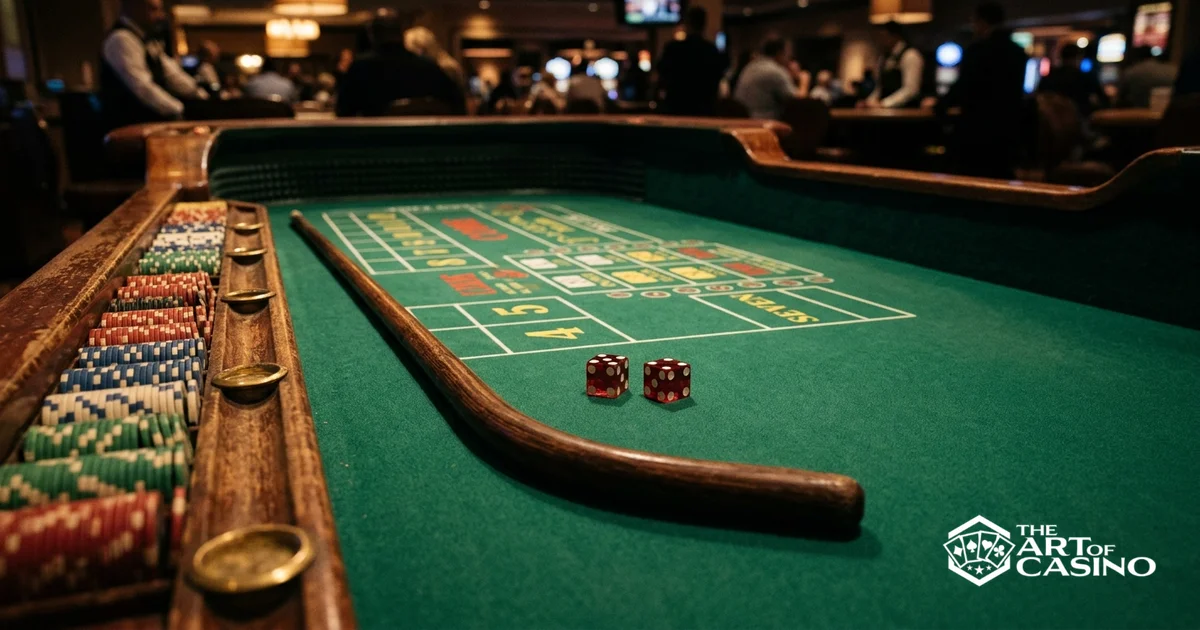
Unlike other table games where one dealer works alone, craps uses a four-person crew.
Crew Positions
Boxperson (seated, supervises):
- Seated at center of table, facing players
- Supervises the game and settles disputes
- Manages the chip bank
- Watches for irregularities
- Not part of the dealing rotation (supervisory role)
Stickperson:
- Stands at center of table, opposite the boxperson
- Controls the dice with a curved stick
- Calls the game (announces rolls, prompts betting)
- Manages center proposition bets
- Sets the pace and energy of the game
Base dealers (two):
- Stand at each end of the table
- Handle bets on their half of the layout
- Pay winners, collect losers on their section
- Place and move point bets
- Handle buy, lay, and place bets
Crew Rotation
Dealers rotate positions every 20-30 minutes:
- Base dealer moves to stick
- Stick moves to break
- Dealer returning from break takes base
This rotation ensures everyone gets stick time (most demanding) and break time.
Crew Dynamics
Working as a team: Craps dealing is genuinely collaborative. The crew must work together smoothly, anticipating each other's needs and maintaining game flow.
Communication: Crew members communicate constantly, confirming bets, verifying payouts, alerting to issues. Clear, concise communication keeps the game running smoothly.
Covering for each other: When one position gets busy, others may assist. The stick might help verify a payout. A base dealer might call out a bet the stick missed.
Shared reputation: A crew develops a reputation together. Good crews attract players; struggling crews lose action.
What Makes Craps Challenging
The Learning Curve
Time to proficiency: While blackjack dealing can be learned in weeks, craps proficiency takes 3-6 months of dedicated practice and floor experience.
Why it takes longer:
- Dozens of different bet types
- Complex payout odds (7:5, 9:5, 7:6, etc.)
- Multiple positions to master
- Crew coordination skills
- Game calling and stick work
Mental Demands
Simultaneous tracking: Base dealers track multiple bets for multiple players simultaneously. Each player might have pass line with odds, place bets on multiple numbers, and proposition bets, all requiring different handling.
Instant calculations: Payouts must be calculated instantly for non-standard amounts at various odds. $22 inside pays differently than $27 across pays differently than $52 six and eight.
Remembering positions: Players' bets must be tracked by table position. On a full table, that's 16+ different player positions with multiple bets each.
Physical Demands
Reaching across the table: Craps tables are large. Moving chips and dice across the layout requires reach and accuracy.
Standing position: The standing positions at a craps table involve more movement than blackjack, reaching, leaning, turning.
Stick handling: The stick position requires coordinated movement to retrieve dice, push dice to shooter, and manage center bets.
Energy Demands
Calling the game: The stick position requires sustained verbal energy, announcing every roll, prompting bets, keeping excitement high.
Managing excitement: Hot rolls create intense excitement. Maintaining composure while moving at high speed requires mental discipline.
Sustained attention: A hot roll can last 20-30 minutes without a seven. Maintaining focus through extended action is exhausting but essential.
Income as a Craps Dealer
Base Pay
Craps dealer base wages are typically identical to other table game dealers at the same property, the premium comes from tips, not hourly rate.
Tip Income
Craps-specific advantages:
- Proposition bet tips ("for the boys")
- Communal winning atmosphere
- Hot roll generosity
- Higher average bet sizes at many craps tables
How much more? On average, craps-heavy shifts earn 10-30% more in tips than blackjack-heavy shifts at the same property. This varies significantly by property, player mix, and how the craps games run that day.
Property Variation
Properties with strong craps programs generate better income:
- Vegas Strip properties with multiple craps tables
- Properties that attract dice players specifically
- Casinos with higher table limits and better player demographics
Properties with minimal craps action offer less advantage:
- Single craps table often empty
- Low-limit games
- Player base that doesn't play craps
A Typical Craps Shift
The Rotation
Standard pattern (varies by property):
- 20-30 minutes on base position
- 20-30 minutes on stick
- 20 minutes on break
- Repeat through shift
Why rotation matters:
- Stick position is vocally and mentally demanding
- Base position involves more physical reaching
- Rotation prevents burnout in any one role
- Ensures all dealers get stick experience
Shift Flow
Opening a table:
- Verify chip inventory
- Check table equipment (dice, stick, layouts)
- First dealer takes base position
- Wait for players or deal to any present
During play:
- Maintain game flow through rotations
- Handle player arrivals and departures
- Manage chip inventory
- Coordinate with pit boss for fills or credits
Closing a table:
- Color up remaining players
- Secure chip tray
- Account for inventory
Energy Management
Stick position:
- High energy, vocal role
- Mentally demanding
- Need to maintain enthusiasm even when tired
- Rotation provides recovery time
Base position:
- More physically demanding (reaching, leaning)
- Complex bet tracking
- Can be quieter role
- Requires sustained focus
Break recovery:
- 20-minute breaks between positions
- Essential for maintaining performance
- Use breaks for actual rest, not just standing around
Player Interaction at Craps
The Social Dynamic
Craps tables are uniquely social. Players often root for each other, celebrate together, and create a communal experience.
Creating atmosphere: The stick position especially influences table energy. A good stick person can elevate the entire table experience through calls, pacing, and enthusiasm.
Managing the table: Unlike blackjack where interaction is dealer-to-individual-player, craps involves managing group dynamics. The table has a collective mood that skilled dealers influence.
The Shooter Relationship
Shooter as performer: The shooter is momentarily the center of attention. How dealers interact with shooters affects the entire table experience.
Respectful treatment: Every shooter deserves professional respect regardless of results. Don't blame shooters for sevens or over-credit them for hot rolls.
Keeping shooters moving: Some shooters develop rituals that slow the game. Balance respecting their process with maintaining reasonable game pace.
Common Player Types
The dice setter: Arranges dice carefully before throwing. Respect the practice without letting it unreasonably slow the game.
The superstitious player: Follows rituals, avoids certain words, has lucky positioning. Accommodate reasonably without reinforcing genuinely problematic superstitions.
The new player: Confused by craps complexity. Help without being condescending. Suggest simple bets (pass line) if asked.
The wrong bettor: Bets against the shooter (don't pass/don't come). Treat identically to right bettors, their money is equally valid.
The proposition player: Focuses on center bets with high house edges. Serve them professionally; their betting choices are their business.
Maximizing Income as a Craps Dealer
Creating a Great Table
Energy level: Appropriate enthusiasm without forcing it. Read the table, some groups want high energy, others prefer more subdued dealing.
Game pace: Keep the game moving without rushing players. Dead time between rolls reduces tips; so does feeling hurried.
Accurate, fast work: Players notice when payouts are quick and correct. Fumbling and errors reduce confidence and tips.
The Stick Position Opportunity
The stick position has the most influence on table atmosphere and tip generation.
Calling style: Develop a calling style that's professional, clear, and appropriately energetic. Avoid clichéd phrases that feel forced.
Proposition bet handling: Manage center bets smoothly. Quick payouts on proposition winners during hot rolls keep money in play and tips flowing.
Dice management: Get dice to the shooter quickly. Dead time waiting for dice kills momentum.
Team Contribution
Supporting your crew: Strong crews earn more together. Support teammates having difficult moments.
Not showing up teammates: Avoid making crewmates look bad, even subtly. This damages crew dynamics and ultimately hurts everyone's income.
Sharing workload: When one position is slammed, help where you can. Crew cooperation creates better player experiences.
Career Progression with Craps
Learning Craps
Best approaches:
- Dealer school with comprehensive craps curriculum
- Property training programs specifically for craps
- Practice extensively before and during floor training
Timeline:
- Basic procedures: 4-8 weeks
- Base dealer proficiency: 3-4 months
- Stick proficiency: 4-6 months
- Confident, fast dealing: 6-12 months
Moving Up
Using craps skills:
- Apply to better properties emphasizing craps experience
- Request craps-heavy shifts when available
- Build reputation as a strong craps dealer
High-limit craps:
- Some properties have separate high-limit craps with separate toke pools
- Access requires demonstrating skill and composure
- Income potential often exceeds standard pit
Beyond Dealing
Craps box person:
- First supervisory step, seated at the table
- Requires exceptional game knowledge
- Salary position (no tips) but career advancement
Craps pit management:
- Overseeing multiple craps games
- Scheduling and personnel management
- Senior career position
The Downsides
Difficulty
Steeper learning curve: Craps takes significantly longer to learn than blackjack or roulette. Some people never fully master it.
Sustained complexity: Even after learning, craps remains mentally demanding. Every shift requires full attention.
Error consequences: Errors on craps are visible and affect multiple players. The pressure of accuracy is constant.
Physical Demands
Reaching: The table layout requires reaching across significant distances repeatedly.
Standing positions: Less stable standing than blackjack, more movement, more strain.
Vocal demands: Stick calling uses the voice for extended periods. Vocal strain is real.
Crew Dynamics
Dependence on others: Your performance partly depends on crewmates. Weak crew members affect everyone.
Personality conflicts: Working closely with the same people shift after shift can create friction.
Blame dynamics: When mistakes happen, crew situations can become uncomfortable.
Is Craps Dealing Right for You?
Good Fit If You:
- Enjoy mental challenges and complexity
- Thrive in high-energy, social environments
- Can maintain focus for extended periods
- Work well on teams
- Have strong math skills
- Want higher earning potential
- Can handle the pressure of fast-paced action
Poor Fit If You:
- Prefer simpler, more repetitive tasks
- Don't enjoy sustained mental demands
- Have difficulty with team dynamics
- Struggle with quick mental math
- Prefer lower-intensity work environments
- Don't want to invest months in learning
Frequently Asked Questions
How long does it take to learn craps dealing?
Basic competence takes 3-6 months of dedicated practice and floor experience. Full proficiency, where dealing feels automatic and fast, takes 6-12 months. The learning curve is significantly steeper than blackjack or roulette.
How much more do craps dealers make?
On average, craps dealers earn 10-30% more than blackjack-only dealers at the same property. At casinos with strong craps programs, the premium can be higher. The advantage comes from the tipping culture, not base pay differences.
Can I deal craps without learning blackjack first?
Technically yes, but most career paths start with blackjack. Blackjack teaches fundamental skills, chip handling, payout calculations, player management, that apply to craps. Most dealer schools teach blackjack before craps.
What's the hardest part of dealing craps?
Most dealers cite the complexity of tracking multiple bets for multiple players simultaneously, especially during active games. The mental load of remembering positions, calculating various odd payouts, and maintaining game flow is demanding.
Do I need to be good at math for craps?
Yes. Craps payouts involve various odds (7:5, 9:5, 7:6, and more) that must be calculated instantly for non-standard amounts. Mental math ability is essential, there's no time for calculation during an active game.
Is stick position really harder than base?
The stick position is vocally demanding and sets the game pace, which creates pressure. Base positions involve more complex bet handling and payout calculations. Both are demanding in different ways. Most dealers find one or the other more challenging based on personal strengths.
Additional Resources
- How to Deal Craps - Step-by-step procedures
- How to Become a Casino Dealer - Complete career guide
- Casino Dealer Salary Guide - Detailed income information
- Craps - Game rules for player perspective