
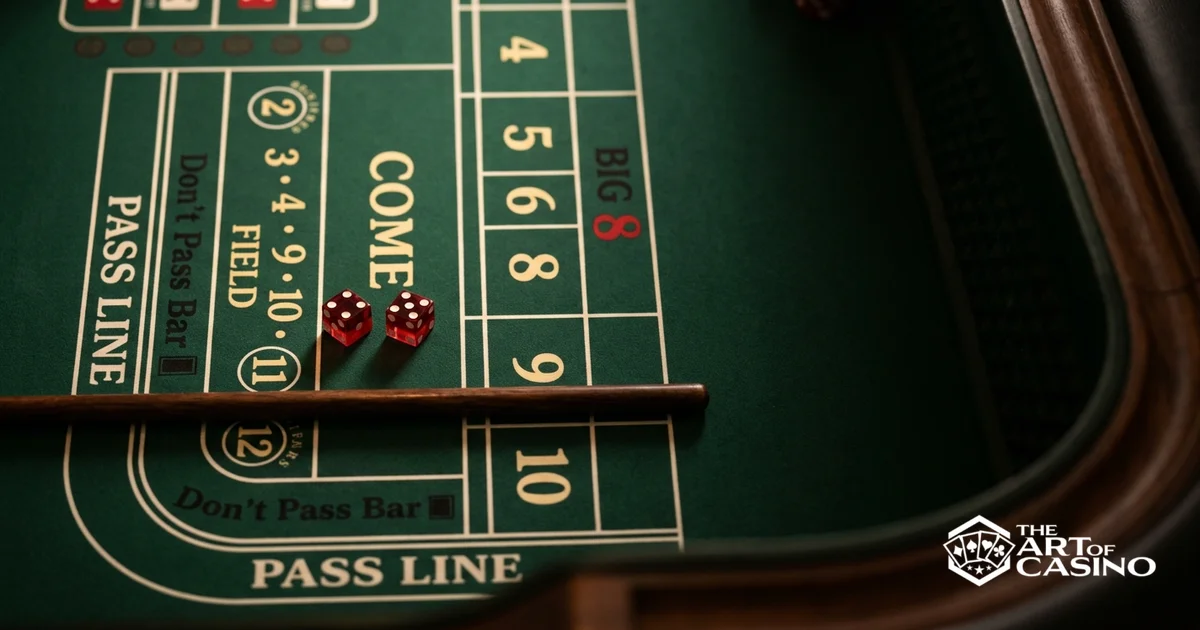
Craps is the most complex table game to deal. The crew structure, multiple simultaneous bets, and fast pace make it challenging, but also rewarding for dealers who master it.
This guide covers the essential procedures that every craps dealer needs to know.
The Craps Crew
Four-Person Team
Boxperson: Sits at center of table, supervises the game, handles buy-ins, monitors payouts, makes decisions on disputes.
Stickperson: Controls dice, calls the game, handles proposition bets in center of layout. Rotates between stick and base positions.
Base Dealers (2): One on each end, handle all bets on their half of the layout. Pay winners, collect losers, book bets.
Crew Dynamics
Communication: The crew works as a unit. Clear communication prevents errors.
Coverage: Each position covers specific areas. Know your responsibilities.
Rotation: Crews typically rotate positions every 20-30 minutes.
Game Setup
Opening Procedures
Verify inventory: Check chip rack and fill. Confirm opening bank amount matches documentation.
Equipment check: Dice examined and matched. Stick, puck, and markers in place.
Puck positioning: OFF puck visible on Don't Come bar.
Dice Control
Dice selection: Five dice presented. Shooter selects two.
Remaining dice: Placed in bowl. Never leave extra dice accessible.
Dice inspection: Between shooters, box examines dice before presenting to new shooter.
The Come-Out Roll
Before the Roll
Puck status: OFF puck indicates come-out roll.
Allowable bets:
- Pass Line
- Don't Pass
- Field
- Propositions
- Big 6/8
Not active: Place bets, Come, Don't Come (no point established).
Come-Out Results
7 or 11:
- Pass Line wins (1:1)
- Don't Pass loses
- Mark nothing, new come-out
2, 3, or 12:
- Pass Line loses
- Don't Pass wins on 2 or 3
- Don't Pass pushes on 12 (bar)
- New come-out roll
Point established (4, 5, 6, 8, 9, 10):
- Move puck to point number (ON side up)
- Place bets now working
- Game continues until point or 7
Point Cycle
After Point Established
Puck position: ON puck sits on the point number.
Working bets:
- Pass Line (locked)
- Don't Pass (locked)
- Place bets
- Come and Don't Come
- Hardways
- Odds behind Pass/Don't Pass
Point Rolled
Pass Line wins (1:1): Pay all Pass Line bets.
Don't Pass loses: Collect Don't Pass bets.
Odds payouts: Pay true odds based on point:
- 4/10: 2:1
- 5/9: 3:2
- 6/8: 6:5
Reset: Puck to OFF, new come-out.
Seven-Out
Pass Line loses: Collect all Pass Line and odds bets.
Don't Pass wins (1:1): Pay Don't Pass and lay odds.
Come bets lose: Collect all Come bets with odds on numbers.
Don't Come bets win: Pay all Don't Come bets on numbers.
New shooter: Dice pass to next shooter, new come-out.
Base Dealing Procedures
Bet Placement
Player positioning: Bets placed relative to player position. Know your base's player map.
Bet verification: Repeat bets verbally for clarity. "Twenty-five on the six."
Chip positioning: Place bets in proper location on layout. Each position has designated spots.
Place Bets
Booking the bet:
- Repeat amount and number
- Place chips in correct location
- Announce to box if necessary
Payouts (inside numbers):
- 6 and 8: 7:6 (must be in $6 increments)
- 5 and 9: 7:5 (must be in $5 increments)
- 4 and 10: 9:5 (must be in $5 increments)
Working status: Place bets OFF on come-out unless player requests otherwise.
Come Bets
Initial placement: Bet placed in Come area.
After roll:
- 7 or 11: Pay 1:1, same spot
- 2, 3, 12: Lose
- Number: Move bet to that number
Odds on Come: Player hands odds to dealer, placed offset on Come bet.
Don't Come Bets
Initial placement: Bet in Don't Come bar.
After roll:
- 7 or 11: Lose
- 2 or 3: Win 1:1
- 12: Push (bar)
- Number: Move behind that number
Laying odds: Heeled (angled) to indicate lay odds.
Stickperson Procedures
Dice Control
Presentation: Push dice to shooter with stick.
After roll: Retrieve dice, hold until all bets resolved.
Dice off table: Call for inspection. Box approves same dice or new selection.
Calling the Game
Pre-roll: Announce point or come-out status.
Roll result: Call the number clearly. "Six, easy six."
Specify winners: "Winner on the front line, pay the line."
Center Bets (Proposition Bets)
Handling: Catch tossed bets, place on layout.
Booking: Track which player owns which proposition bet.
Payouts: Coordinate with box for correct amounts. Push payment toward player with stick.
Common Propositions
Hardways:
- Hard 4/10: 7:1
- Hard 6/8: 9:1
One-roll:
- Any 7: 4:1
- Any Craps: 7:1
- 2 (Aces): 30:1
- 12 (Boxcars): 30:1
- 3: 15:1
- 11 (Yo): 15:1
C&E: Craps and Eleven split bet.
Horn: 2, 3, 11, 12 combined (4-way bet).
Payout Procedures
Base Dealer Payouts
Order: Pay from stick end toward yourself (away from dice).
Positioning: Push payments to edge of layout near player.
Verification: Box monitors all payouts.
Stickperson Payouts
Method: Use stick to push chips toward winning player.
Coordination: Clear with box before pushing significant payouts.
Making Change
During game: Color changes at natural breaks, not during roll.
Buy-ins: Handled by box. Money in, call amount, box slides chips.
Odds Bets
Behind Pass Line
Limits: Property-specific (3x, 4x, 5x, 10x, 100x).
Placement: Player places odds behind Pass Line bet.
Payouts: True odds, no house edge on odds portion.
Laying Against
Don't Pass odds: Heeled (bridged) behind Don't Pass bet.
Math: Reverse of taking odds. Lay more to win less.
Come Bet Odds
Handling: Player tosses odds to dealer, who places on Come bet (offset to distinguish from flat bet).
Off status: Come odds automatically OFF on come-out unless player specifies.
Buy and Lay Bets
Buy Bets
Concept: Pay commission for true odds on place numbers.
Commission: 5% of bet (when to collect varies by property).
When used: Players buying 4 or 10 for better odds than place bet.
Lay Bets
Concept: Betting against a number. Lay more to win less.
Commission: 5% of potential win.
Placement: Behind number in Don't area.
Game Protection
Dice Security
After roll: Secure dice immediately with stick.
Examination: Regular inspection for tampering or switching.
Control: Never leave dice unattended.
Bet Verification
Late bets: No bets after dice leave shooter's hand.
Past posting: Watch for bets added or increased after outcome known.
Pinching: Watch for bets reduced after losing roll.
Crew Communication
Announce everything: Bets, payouts, changes, verbalize for crew awareness.
Eyes up: Box and stick monitor the whole game.
Common Scenarios
Seven-Out Sequence
- Stickperson calls "Seven out!"
- Collect Pass Line and Come bets
- Pay Don't Pass and Don't Come
- Collect/pay all other bets appropriately
- Puck to OFF
- Stickperson presents dice to new shooter
Busy Table Management
Prioritize: Handle bets systematically, not by loudest player.
Communication: Call "no more bets" clearly and early enough.
Assistance: Box supports with capacity issues.
Dispute Resolution
Stay calm: Never argue with players.
Involve box: Boxperson makes final decisions.
Surveillance: Eye in the sky resolves factual disputes.
Learning Craps Dealing
Progression
Start with base: Learn base dealing before stick.
Add complexity: Master Pass/Don't Pass before all proposition bets.
Practice: Craps requires more practice than other games.
Common Mistakes
Payout errors: Verify calculations, especially on complex bets.
Bet placement: Each spot corresponds to a player position. Learn the map.
Timing: Resolve bets in proper sequence. Don't rush.
Building Speed
Comes with experience: Craps speed develops over months, not days.
Accuracy first: Correct and slow beats fast and wrong.
Crew support: Good crews help develop new dealers.
Frequently Asked Questions
How long does it take to learn craps?
Craps requires more training time than any other table game. Basic competency takes 6-8 weeks of focused training. Comfortable dealing takes months of actual floor experience.
What's the hardest part of craps?
Tracking multiple bets simultaneously while calculating different payouts under time pressure. The math isn't hard, the mental juggling is challenging.
Do I need to know craps to be a dealer?
Not initially. Many dealers work for years dealing only blackjack. However, craps proficiency significantly increases earning potential and job opportunities.
What if I make a payout mistake?
Correct it immediately. Surveillance records everything. Honest mistakes are corrected; the key is catching and fixing errors quickly.
Additional Resources
- Working as a Craps Dealer - Career perspective
- How to Become a Casino Dealer - Complete career guide
- Craps Rules - Player-focused rules