
Roulette dealing requires precise chip handling, quick mental math, and smooth wheel operation. While conceptually simpler than craps, roulette demands its own specialized skills.
This guide covers the essential procedures for professional roulette dealing.
Equipment and Setup
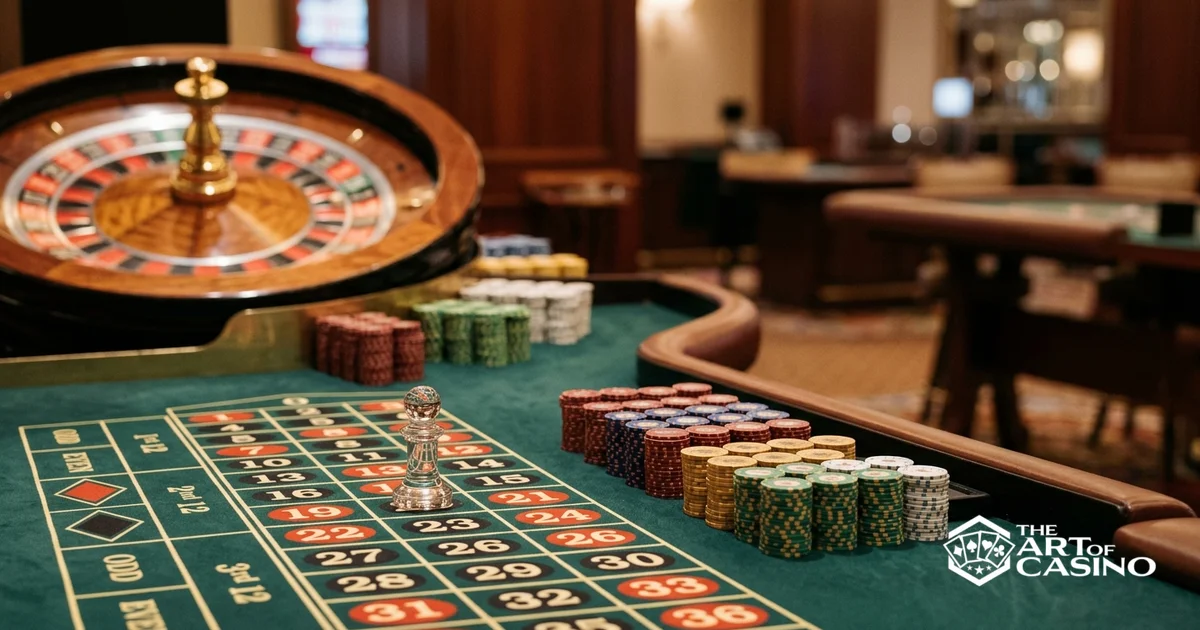
The Wheel
American wheel: 38 pockets: 0, 00, and 1-36. Numbers arranged to balance odds/evens and red/black.
European wheel: 37 pockets: 0 and 1-36. Single zero reduces house edge.
Wheel inspection: Check for damage, debris, or irregularities. Wheel should spin freely without wobble.
The Ball
Material: Typically synthetic (acetal, nylon, or phenolic resin); ivory was used historically but is no longer standard. Some properties use different ball sizes.
Inspection: Check for chips, cracks, or damage before each shift.
Spinning: Practice consistent ball release for unpredictable results.
The Layout
Betting surface: Numbers arranged in three columns of 12. Outside bets surround the number grid.
Chip placement: Each bet type has specific placement requirements.
The Dolly (Marker)
Purpose: Marks the winning number. Placed on the layout after the ball lands.
Use: No bets may be touched while dolly is on the layout.
Roulette Chips
Color Chips (Wheel Checks)
Assignment: Each player receives unique colored chips with their chosen value.
Value setting: Player declares value when buying in. Dealer places lammer on rail showing chip value.
Stack counts: Typically 20 chips per stack for easy counting.
Tracking Values
Rails: Sample chips with value markers on the chip rail.
Memory: Remember each player's chip value throughout their play.
Transitions: When player leaves, chips must be cashed out or new value established.
Cash Chips
Table minimums: Cash chips (regular denomination) may be used for outside bets.
Inside bets: Typically require color chips to prevent confusion.
Color Changes and Cash-Out
Changing out: Player gives color chips to dealer, receives cash chips.
Counting: Count stacks publicly. Verify amount with player.
Lammer removal: Remove value marker when player cashes out.
Spinning Procedures
Ball Spin
Technique: Spin ball in opposite direction of wheel rotation.
Consistency: Develop consistent release for fairness and predictability.
Speed: Sufficient rotations for randomness (property minimums apply).
Calling the Game
Before spin: "No more bets" or similar call when ready.
During spin: Allow some betting early in spin (property-specific).
Closing: "No more bets" as ball slows. Wave hand over layout.
After the Spin
Observe landing: Watch ball until it settles in final pocket.
Announce result: Call number, color, odd/even, high/low. "Seventeen, black, odd."
Place dolly: Mark winning number on layout before touching any chips.
Bet Types and Placement
Inside Bets
Straight up (1 number): Chip centered on the number.
Split (2 numbers): Chip on the line between two numbers.
Street (3 numbers): Chip on the outer edge of a row of three.
Corner (4 numbers): Chip on the intersection of four numbers.
Five-number (0, 00, 1, 2, 3): American only. Chip on the corner where 0/00 meets 1/2/3.
Line (6 numbers): Chip on the outer corner of two adjacent streets.
Outside Bets
Column (12 numbers): Chip in "2:1" box at bottom of column.
Dozen (1-12, 13-24, 25-36): Chip in designated dozen box.
Red/Black: Chip in colored diamond area.
Odd/Even: Chip in labeled section.
High/Low (1-18 or 19-36): Chip in labeled section.
Payout Procedures
Payout Order
Standard sequence:
- Sweep losing bets
- Pay outside bets (far to near)
- Pay inside bets (bottom to top)
- Remove dolly
- Begin new spin
Inside Bet Payouts
Straight up: 35:1 $1 bet → $35 + original $1 = $36 total
Split: 17:1 $1 bet → $17 + original = $18 total
Street: 11:1 $1 bet → $11 + original = $12 total
Corner: 8:1 $1 bet → $8 + original = $9 total
Five-number (0, 00, 1, 2, 3): 6:1 $1 bet → $6 + original = $7 total (American/double-zero wheels only)
Line: 5:1 $1 bet → $5 + original = $6 total
Outside Bet Payouts
Column/Dozen: 2:1 Red/Black, Odd/Even, High/Low: 1:1
Multi-Bet Calculations
Winning number may hit multiple bets: Calculate each winning bet separately, then total.
Example: 17 wins for a player with (17 is black):
- $5 straight on 17 (35:1) = $175
- $5 corner on 14-15-17-18 (8:1) = $40
- $5 on black (1:1) = $5
- Total winnings: $220 (plus original bets returned)
Chip Cutting
Building payouts: Cut chips from your stack, not the bank, to build payout stacks.
Accuracy: Verify stack heights before pushing payout.
Speed: Practice builds speed without sacrificing accuracy.
Sweeping and Clearing
Losing Bet Collection
Sequence: Inside bets first, then outside bets.
Technique: Use proper hand motions to collect chips cleanly.
Verification: Ensure no winning bets are accidentally collected.
Organizing the Bank
Color sorting: Maintain organized bank for efficient payouts.
Restocking: Request fills before running low on any denomination.
Game Protection
Late Betting
Common cheat: Adding bets after result is known.
Prevention: Close betting clearly. Watch layout during ball descent.
Response: Remove late bets. Warn player. Call supervisor for repeat offenses.
Past Posting
Definition: Placing or moving bets after outcome determined.
Watch points: Hands near layout after ball lands.
Dolly importance: While dolly is on layout, no bets may be touched.
Bet Capping
Definition: Adding chips to winning bet after outcome.
Prevention: Observe hands after winning number known.
Wheel Tracking
Player strategy: Some players try to predict outcomes based on wheel patterns.
Dealer response: Vary spin speed and release point. Report suspicious behavior.
Dealer Calls
Standard Announcements
Before spin: "Place your bets."
During spin: "No more bets" (with hand wave).
After landing: "[Number], [color], [odd/even]." "Seventeen, black, odd."
Zero/Double zero: "Zero" or "Double zero, green."
After payout: "Place your bets."
Clarity
Volume: Loud enough for all players.
Enunciation: Clear pronunciation prevents confusion.
Consistency: Same calls every time builds player confidence.
Handling Chip Colors
Buying In
Announce: Call the buy-in amount.
Exchange: Provide color chips matching requested value.
Mark: Place lammer on rail showing chip value.
During Play
Value disputes: Reference the lammer. If unclear, call supervisor.
Color confusion: Similar colors require extra attention. Some properties use patterns.
Cashing Out
Count publicly: Count chip stacks where player can see.
Verify: Confirm total before exchanging for cash chips.
Clear rail: Remove lammer after player leaves.
Wheel Maintenance
Between Spins
Ball check: Verify ball isn't damaged.
Pocket check: Ensure nothing in pockets affects ball landing.
During Shift
Spin quality: Wheel should spin smoothly. Report any wobble or noise.
Rotor speed: Maintain consistent wheel rotation.
Reporting Issues
Any irregularity: Report immediately to floor supervisor.
Bias concerns: Suspected biased wheels require immediate attention.
Common Scenarios
Multiple Winners
Same number: Multiple players can win on the same number.
Individual payouts: Calculate and pay each player separately.
Order: Pay methodically to avoid confusion.
Disputes
Bet ownership: Color chips solve most disputes. Cash chips on outside bets may require clarification.
Supervisor: Call floor for unresolved disputes.
Surveillance: Camera review resolves factual disputes.
Ball Off Wheel
Procedure: Call "no spin" if ball leaves wheel before landing.
Re-spin: Return all bets to original positions. Spin again.
Learning Roulette Dealing
Key Skills
Chip cutting: Practice building accurate stacks quickly.
Mental math: Drill payout calculations until automatic.
Ball spinning: Consistent technique requires practice.
Common Mistakes
Dolly placement: Always place dolly before touching chips.
Payout errors: Verify calculations, especially with multiple winning bets.
Premature clearing: Never clear bets before dolly is placed.
Building Speed
Accuracy first: Speed without accuracy creates problems.
Pattern recognition: Common bet combinations become automatic.
Physical practice: Chip handling improves with repetition.
Frequently Asked Questions
How hard is roulette compared to blackjack?
Roulette requires different skills. The payouts are more varied, chip management is more complex, but the game flow is straightforward. Most dealers find it moderate difficulty.
What's the hardest part of roulette dealing?
Quickly calculating payouts when a player has multiple winning bets at different odds. This requires mental math and chip cutting simultaneously.
Why do players get different colored chips?
Color chips prevent disputes about bet ownership. When multiple bets overlap on the layout, color identifies who owns each bet.
What if the ball lands between two pockets?
The ball must settle in one pocket. If unclear, look directly down at the wheel. If still unclear, call supervisor. Surveillance can determine final position.
Additional Resources
- Working as a Roulette Dealer - Career perspective
- How to Become a Casino Dealer - Complete career guide
- Roulette Rules - Player-focused rules