
This guide covers the technical procedures for dealing blackjack, the mechanics, sequences, and physical skills required to run a professional blackjack game. For career advice, income information, and player interaction strategies, see our companion article Working as a Blackjack Dealer.
Pre-Game Setup
Before dealing begins, several setup procedures ensure game integrity and readiness.
Table Inspection
Layout check:
- Betting circles clearly visible and unobstructed
- Table felt clean and in good condition
- Discard rack properly positioned
- Shoe or pitch deck area clear
Chip tray verification:
- All denominations present and properly organized
- Chips stacked in standard heights (20 chips per stack)
- Sufficient chips for expected action
- Lammers and markers in designated spots
Signage confirmation:
- Table minimum and maximum clearly displayed
- House rules visible (dealer hits/stands soft 17, blackjack pays 3:2 or 6:5)
- Side bet information if applicable
Deck Preparation
Spreading the cards:
- Remove cards from packaging or previous shoe
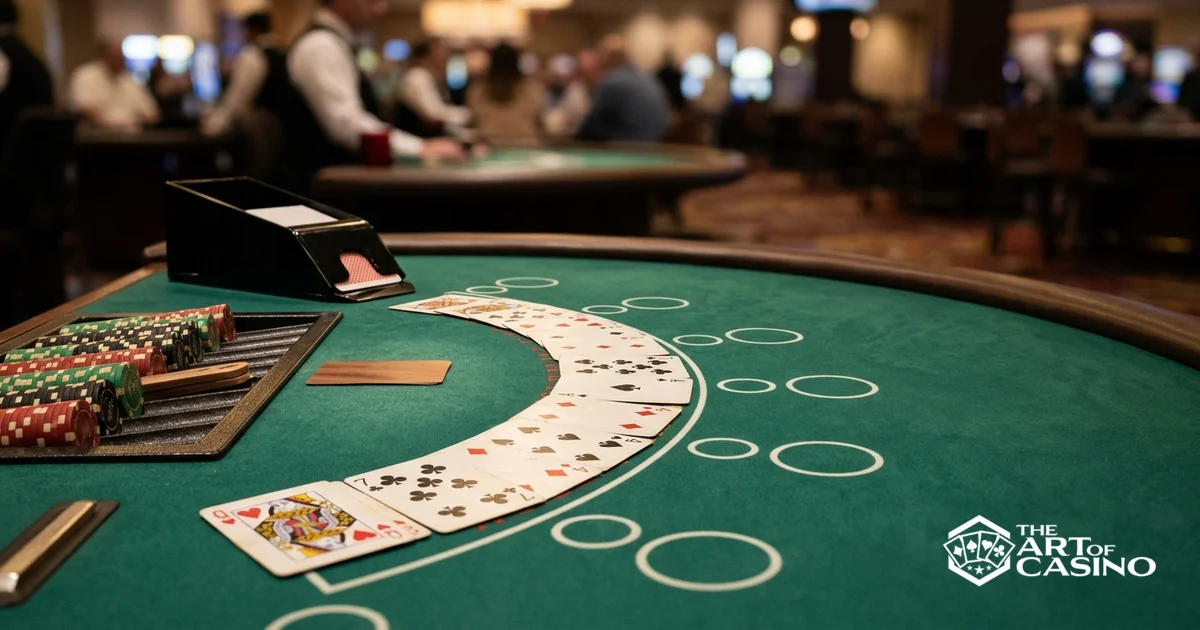
- Spread cards face-up across the table in a ribbon spread
- Verify all cards present and undamaged
- Check for missing or duplicate cards
- Display for surveillance verification
The shuffle sequence:
Standard casino shuffle for 6-8 deck shoe:
- Riffle shuffle - Split deck roughly in half, interleave cards
- Strip shuffle - Pull small packets from top, reassemble
- Riffle shuffle - Second interleave
- Strip shuffle - Second strip
- Riffle shuffle - Final interleave
- Square the deck - Align all edges cleanly
Repeat sequence for each portion of the multi-deck shoe.
Offering the cut:
- Present cut card to a player (typically the player to dealer's right)
- Player inserts cut card into the deck
- Complete the cut by moving cards above cut card to bottom
- Insert cut card approximately 1-1.5 decks from the back (penetration varies by house)
Loading the shoe:
- Place shuffled cards into dealing shoe
- Cut card visible, indicating when to shuffle
- Close shoe securely
The Deal Sequence
Opening the Round
Calling for bets:
- "Place your bets" or house-specific phrase
- Allow adequate time for betting
- Watch for late bets approaching the cutoff
Closing betting:
- "No more bets" with clear hand signal (wave across layout)
- Do not deal until all bets are properly placed
- Verify bets are within table limits
Initial Card Distribution
First card round (left to right):
- Deal one card face-up to each betting position with a wager
- Smooth, consistent motion for each card
- Cards placed cleanly in front of betting circles
- Skip empty positions
Dealer up card:
- Deal one card face-up to the dealer position
- Place at standard angle for visibility
Second card round:
- Deal second card face-up to each player position
- Same left-to-right sequence
Dealer hole card:
- Deal second dealer card face-down
- Tuck partially under the up card
- Do not expose the hole card
Hole Card Procedures
When to peek:
- Peek only when up card is an Ace or 10-value card
- Use mirror device or peek method per house procedure
Ace up card sequence:
- Offer insurance: "Insurance open"
- Allow players to place insurance bets (half original wager)
- Close insurance: "Insurance closed"
- Peek at hole card using approved method
- If blackjack: "Blackjack" - reveal card, settle bets
- If no blackjack: proceed with player hands
10-value up card:
- Peek at hole card (no insurance offered)
- If blackjack: reveal and settle
- If no blackjack: proceed normally
Even money option:
- When player has blackjack and dealer shows Ace
- Offer before peeking: "Even money?"
- If accepted: pay 1:1 immediately
- If declined: proceed with insurance/peek sequence
Player Decisions
Handle each player position completely before moving to the next, working left to right.
Hit
Player signal: Tapping or scratching the table, or pointing at cards
Procedure:
- Acknowledge the signal
- Deal one card face-up next to existing cards
- Announce new total if helpful (optional per house)
- Wait for next decision
Bust procedure:
- When hand exceeds 21: "Too many" or simply collect
- Take cards first (place in discard)
- Then collect losing wager
- Move to next position
Stand
Player signal: Waving hand horizontally over cards, palm down
Procedure:
- Acknowledge the signal
- Move immediately to next position
- Do not touch player cards
Double Down
Player signal: Placing additional chips (up to original bet) and holding up one finger, or verbal "double"
Procedure:
- Verify additional bet is placed correctly (beside, not on top of original)
- Verify bet amount is within rules (equal to or less than original)
- Deal exactly one card, typically placed sideways to indicate doubled hand
- Move to next position (no additional cards regardless of total)
Double for less:
- Some houses allow doubling for less than original bet
- Same procedure, note the lesser amount
Split
Player signal: Placing matching bet beside original and making V-sign with fingers, or verbal "split"
Procedure:
- Verify cards are a valid splitting pair (matching values)
- Verify additional bet equals original bet
- Separate the cards, one to each betting position
- Deal one card to first split hand
- Complete first hand fully (hit/stand/double/re-split if applicable)
- Deal one card to second split hand
- Complete second hand fully
Split Aces special rules (most houses):
- Each Ace receives only one card
- No hitting, doubling, or re-splitting
- 21 on split Aces typically pays 1:1, not 3:2 (counts as 21, not blackjack)
Re-splitting:
- If split hand receives another matching card
- House rules vary on number of re-splits allowed
- Same procedure for each re-split
Surrender
When offered (not all houses):
- Late surrender: after dealer checks for blackjack
- Early surrender: before dealer checks (rare)
Procedure:
- Player verbally requests "surrender"
- Collect half the original wager
- Return half to player
- Remove player cards to discard
- Move to next position
Dealer Hand Play
After all player hands are complete:
Revealing the Hole Card
Procedure:
- Flip hole card face-up with smooth motion
- Announce total: "Dealer has [X]"
- Position cards for clear visibility
Playing the Dealer Hand
Standard rules (verify house rules):
- Hit on 16 or less
- Stand on 17 or more (hard 17)
- Soft 17 rule varies: hit or stand per house rules
Drawing cards:
- Deal additional cards face-up
- Announce running total
- Continue until 17+ or bust
Dealer bust:
- Announce "Dealer busts" or "Too many"
- Proceed to pay all remaining hands
Payouts and Collection
Work right to left (opposite of deal direction) for payouts.
Calculating Payouts
Standard payouts:
| Result | Payout |
|---|---|
| Win | 1:1 (even money) |
| Blackjack | 3:2 (or 6:5 per house rules) |
| Insurance | 2:1 |
| Push | No action (bet returned) |
Common payout calculations:
3:2 Blackjack payouts:
- $5 bet = $7.50 (pay $7 + 50¢ chip or round per house rules)
- $10 bet = $15
- $15 bet = $22.50
- $25 bet = $37.50
- $100 bet = $150
6:5 Blackjack payouts (if applicable):
- $5 bet = $6
- $10 bet = $12
- $25 bet = $30
Chip Cutting
Cutting technique:
- Size into the bet to count chips
- Cut out matching stacks from tray
- Verify count visually
- Place payout beside original bet
- Do not place on top of bet until verified
Cutting accuracy:
- Practice cutting exact amounts quickly
- Standard stack heights: 20 chips
- Cut in standard increments (5s, 10s, 20s)
Payout Sequence
Winning hand:
- Cut payout from tray
- Place beside player's original bet
- Do not touch original bet
Losing hand:
- Pick up player's cards first (to discard)
- Then collect losing chips
- Drop chips into tray
Push (tie):
- Knock table twice with knuckles
- Leave bet in place
- Player may pick up or let ride
Blackjack payout:
- Announce "Blackjack"
- Pay 3:2 (or 6:5)
- Collect cards
Clearing the Layout
After all payouts:
- Collect all remaining cards
- Place in discard rack
- Verify layout is clear
- Call for new round of betting
Special Situations
Insurance Payouts
When dealer has blackjack with Ace showing:
- Pay insurance bets first (2:1)
- Then collect original bets that didn't have blackjack
- Push original bets that had blackjack
Multiple Blackjacks
Dealer and player both have blackjack:
- Push on original bet
- Player loses insurance bet (if taken)
Multiple players with blackjack:
- Pay each from right to left
- Same 3:2 payout for each
Misdeal Procedures
Card exposed during deal:
- Complete the round of dealing
- Exposed card typically becomes first card of next round
- Or burn the exposed card (house policy varies)
Card dealt to wrong position:
- Stop immediately
- Call floor supervisor
- Follow house procedure for correction
Error Correction
Payout error caught immediately:
- Call "short pay" or "overpay"
- Request supervisor verification if significant
- Correct the error with player and surveillance aware
Error caught after cards collected:
- Stop game
- Call floor supervisor
- Surveillance review may be required
- Follow supervisor direction
Chip Handling Skills
Tray Organization
Standard arrangement (varies by property):
- Highest denomination on dealer's right
- Descending value moving left
- Keep adequate supply of all denominations
- Maintain neat, squared stacks
Color Changes
Player requests color change:
- Verify it's between hands only (not during active play)
- Count incoming chips clearly
- Announce total: "[Amount] changing color"
- Cut out equivalent in requested denomination
- Drop incoming chips
- Push changed chips to player
Procedure for color up (higher denomination):
- Same as above
- Often done at player departure
Procedure for color down (lower denomination):
- Same procedure
- Verify sufficient small chips in tray
Drop Box Procedures
Dropping cash buy-ins:
- Spread bills on table (face up, in direction of tray camera)
- Announce total: "[Amount] in"
- Cut out equivalent chips
- Push chips to player
- Use paddle to insert bills into drop box
- Never put hands in drop box
Fill requests:
- When tray runs low on any denomination
- Call floor supervisor
- Complete fill paperwork per house procedure
Side Bets
Common side bets have specific procedures:
21+3
Setup:
- Separate betting circle for side bet
- Must be placed before deal
Resolution:
- After initial deal, before player decisions
- Check player's two cards plus dealer up card
- Pay qualifying three-card poker hands:
- Flush, Straight, Three of a Kind, Straight Flush, Suited Three of a Kind
- Collect losing side bets
- Proceed with main game
Perfect Pairs
Resolution:
- After initial deal
- Check if player's two cards are a pair
- Pay scale: Mixed pair, Colored pair, Perfect pair
- Collect losing bets
- Proceed with main game
Insurance Betting
Already covered in hole card procedures above.
Game Protection
Watching for Issues
Bet manipulation:
- Capping (adding chips after seeing cards)
- Pinching (removing chips after unfavorable cards)
- Past-posting (placing bets after cutoff)
Card manipulation:
- Marking cards
- Switching cards
- Hand mucking
Proper response:
- Do not accuse players directly
- Note the activity
- Discreetly notify floor supervisor
- Continue dealing normally until directed otherwise
Procedural Consistency
- Same procedure every time reduces vulnerability
- Never deviate from established sequences
- Maintain card control throughout
- Keep hands visible to surveillance
Frequently Asked Questions
What's the correct shuffle sequence?
Standard casino shuffle is: riffle, strip, riffle, strip, riffle, square. This sequence is repeated for each portion of a multi-deck shoe. Some casinos use shuffle machines, which have their own loading procedures.
When exactly should I peek for blackjack?
Peek only when the up card is an Ace or a 10-value card (10, J, Q, K). With an Ace showing, offer insurance first, then peek. With a 10 showing, peek immediately without offering insurance.
How fast should I be dealing?
Speed develops naturally with practice. Focus on accuracy first. A comfortable pace for experienced dealers is 60-80 rounds per hour on a full table, but this varies by property expectations and game conditions. Never sacrifice accuracy for speed.
What happens if I make a payout error?
Stop immediately, announce the error, and correct it with the player's awareness. For significant errors, call a floor supervisor. Never try to hide errors, surveillance records everything.
How do I handle odd-cent payouts on blackjack?
For 3:2 blackjack on odd amounts (like $5), the payout is $7.50. House rules determine handling: some round up, some round down, some use 50-cent chips. Know your property's specific policy.
Should I announce totals out loud?
Policies vary. Some houses want dealers to announce dealer totals ("Dealer has 17"). Player totals are typically not announced unless requested. Announcing can help game pace and reduce disputes.
Practice Drills
Payout Speed Drill
Practice cutting common payouts until automatic:
- Even money on $5, $10, $15, $25, $100
- 3:2 blackjack on same amounts
- Insurance 2:1 payouts
Deal Speed Drill
With a single deck, practice:
- Dealing to 6 positions plus dealer
- Picking up in reverse order
- Smooth, consistent card placement
Chip Cutting Drill
Practice cutting exact amounts:
- Stacks of 5, 10, 15, 20 chips
- Mixed denomination payouts
- Color changes of various amounts
Additional Resources
- Working as a Blackjack Dealer - Career and income guide
- How to Become a Casino Dealer - Complete career guide
- Blackjack - Game rules for player perspective